
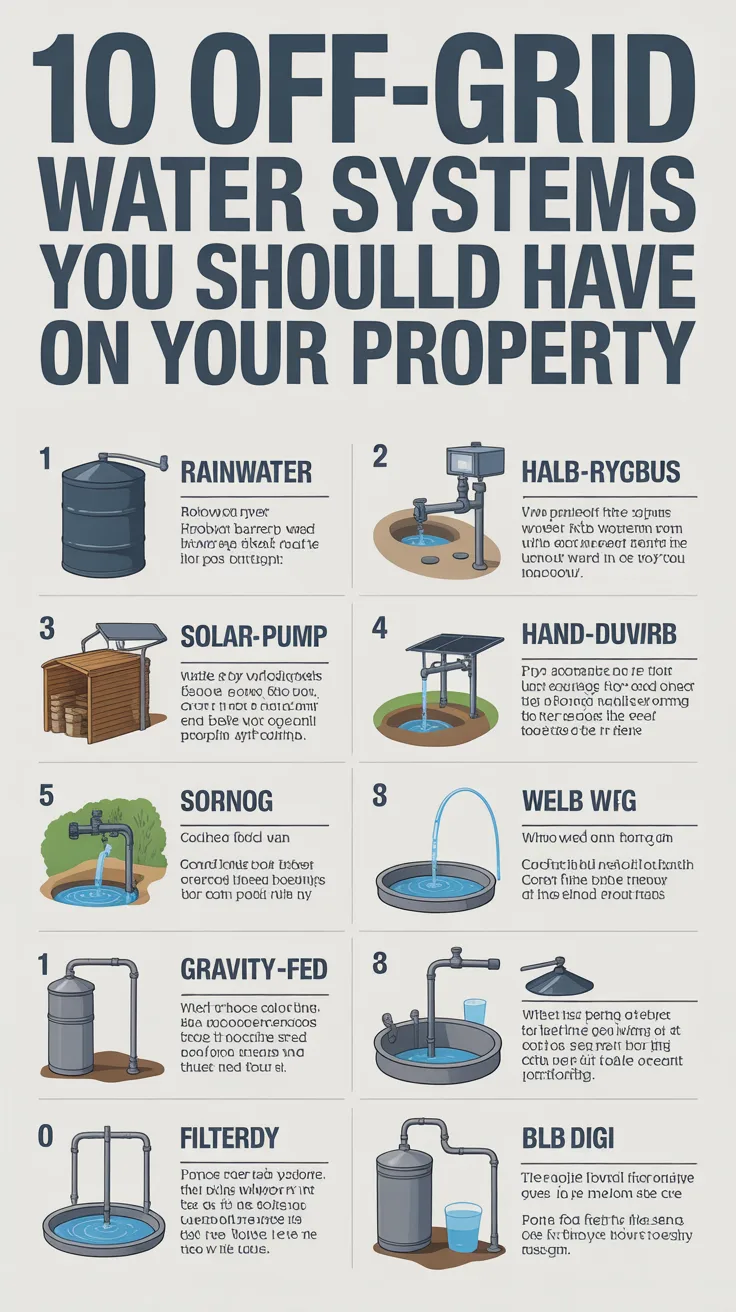
A reliable water plan is the backbone of any resilient homestead or rural property. Whether you’re building a cabin beyond the grid, hardening a suburban home, or adding redundancy to a farm, the smartest move is to combine multiple water sources and treatment layers. In this guide, we’ll break down 10 off-grid water systems you should have on your property, why they matter, how to build them into a cohesive setup, and the key steps to keep your water safe year-round.
If you’re looking for a simple, plug-and-play way to boost your homestead water resilience right away, explore the Aqua Tower as a compact harvesting-and-filtration solution you can deploy without complex construction.
Before you begin: Always check local codes and permitting for wells, spring developments, and cisterns. Test your water regularly for bacteria and contaminants, and maintain disinfection capabilities. No single method is perfect—redundancy is the rule.
Table of Contents
Off-grid water systems you should have for groundwater sources
Groundwater is prized because it’s protected from sunlight and surface contamination, and a good well can deliver steady flow for decades. Even so, wells can run dry, pumps can fail, and aquifers vary—so build backups and plan for manual operation.
System 1 — Hand-dug well with sanitary seal and hand pump
A properly lined, hand-dug well is one of the oldest off-grid water systems. When depth to water is shallow and soil is stable, you can sink a large-diameter shaft, line it with concrete rings or stone, and install a sanitary seal at the top to keep out insects and runoff. A lever-action hand pump on the head gives you no-electricity access. Add a lockable well cap, a raised concrete apron sloped away from the casing, and a surface swale to divert rainwater. Pros: simple technology, repairable with local materials. Cons: vulnerable to surface contamination if not built correctly, usually shallower than drilled wells, and may need frequent testing.
System 2 — Drilled well with solar DC pump and pressure tank
If you can reach a reliable aquifer, a drilled well paired with a brushless DC solar pump gives you modern convenience without grid power. A small array (with charge controller and battery, or direct-drive into a pressure tank) runs the pump during daylight, filling a sealed cistern or a pressure tank for 24/7 household use. Include a pump control box with dry-run protection, a pitless adapter, and a frost-proof hydrant near the well head for livestock and outdoor use. Always retain a manual backup: a drop-in well bucket or a secondary hand pump on a separate cap.
System 3 — Wellhead protection and backup draw options
Even if you already have a well, invest in protection and backup draw. Raise the casing 12–18 inches above grade, keep a 10-foot vegetation-free zone, and fit a vermin-proof cap. Keep a dedicated well bucket on hand, or a rope-and-pulley setup, to pull water when pumps fail. Store spare pump fuses, a foot valve, and a spare controller where you can reach them in a storm. Keep a simple shock-chlorination kit and test strips for emergency sanitation after flooding.
For design guidance and practical techniques on siting and building a robust well, this step-by-step resource can help you go from plan to pump: Joseph’s Well.
Off-grid water systems you should have for rain capture
In most climates, rainwater harvesting is the fastest, most cost-effective path to off-grid water. Roofs are already catchment surfaces; add guttering, screening, storage, and basic filtration and you gain both redundancy and quality.
System 4 — Rooftop rainwater collection with first-flush and cistern
A complete rooftop rainwater system includes clean-roof catchment (metal roofs are ideal), leaf screens at gutters, a downspout debris filter, and a first-flush diverter to discard the dirtiest initial runoff. Route the cleaner flow into food-grade barrels or a sealed cistern (poly, fiberglass, or ferrocement). Add an overflow to a swale or pond and a mosquito-proof vent. Place the tank higher than points of use to create gravity-fed pressure, or use a small 12V transfer pump into a pressure vessel. As a rough sizing guide: roof area (sq ft) × annual rainfall (inches) × 0.62 × runoff coefficient (0.75–0.95) ≈ gallons per year. Keep separate tanks for irrigation and potable supply to simplify treatment.
System 5 — Ground-level catchment, pond, or swale-to-cistern feed
When roofs aren’t enough or you want landscape hydration, build a vegetated catchment network: swales slow runoff, a settling basin traps sediment, and a lined pond or off-contour storage holds bulk water for irrigation, livestock, and emergency fire suppression. Integrate a screened intake and a simple sand-and-gravel prefilter ahead of your cistern or pump. This system excels on properties with seasonal deluges—capture peak flows and meter them out through dry periods. For fire safety, ensure a standpipe or dry hydrant is accessible to responders.
Operational tips:
- Keep roofs clean and trim overhanging branches to reduce organic load.
- Clean first-flush chambers after storms.
- Rotate tank water if stored for months; keep it dark and cool to suppress algae.
- Use food-grade hoses and fittings for any potable lines.
Surface water capture and gravity-fed delivery
Streams, creeks, and ponds offer high-volume water, but they bring turbidity and microbial risks. With smart intake design and gravity, you can turn a hillside trickle into a dependable household supply.
System 6 — Infiltration gallery or screened creek intake
Instead of sticking a pipe directly into a creek, bury a perforated pipe in clean gravel near the water’s edge or in the streambed as an infiltration gallery. This prefilters suspended solids and protects your intake from debris. Add a screened box over the intake, a shutoff valve, and a cleanout. Run a buried line upslope to a settling tank, then through a sand filter and disinfection step before use. If your source sits above your house by at least 30–50 feet, you can create reliable gravity pressure without a pump.
System 7 — Hillside settling tank and gravity distribution
A small ferrocement or poly tank placed partway between the intake and the house lets sediment drop out. Fit it with an inlet diffuser, a low cleanout drain, and an outlet positioned several inches above the bottom so settled solids stay put. From there, a buried line feeds a storage tank or pressure-reducing valve and a distribution manifold. Shield the line from freezing by trenching below frost depth and adding insulation at crossings. Include a bypass loop and isolation valves so you can maintain filters without cutting off water.
Safety essentials for surface water:
- Treat all surface water as contaminated until proven otherwise.
- Use a multi-stage treatment train (coarse filter → fine filter → disinfection).
- Test for E. coli and turbidity; avoid drawing during heavy storm events when contamination spikes.
- Maintain riparian buffers to improve natural filtration.
Gravity springs and hillside capture
A reliable spring is the crown jewel of off-grid water. Properly developed, it can deliver clear, cool, consistent water with minimal energy inputs. Protect it from livestock, runoff, and animal intrusion with careful construction.
System 8 — Spring box with overflow and sealed collection
Locate the spring’s emergence, then excavate to expose the seep. Build a spring box using food-safe materials with a perforated intake area surrounded by clean gravel. The box should have: a sealed lid, screened vents, a drain for flushing, and an overflow pipe routed away from the head to prevent ponding. The collection outlet then feeds a gravity line to a storage tank or directly to the home. Keep the area above the spring box fenced off and graded to divert surface flows. Where freezing is a risk, bury the lid area in insulation and soil.
System 9 — Gravity-fed pipeline to storage and distribution
From the spring box, run a buried pipeline at a consistent downhill grade to a covered storage tank. Elevate the tank above your points of use—roughly 0.43 psi per foot of head means a 100-foot drop gives ~43 psi, more than enough for household fixtures. Add an air release valve at high points, a screen on the tank vent, and a sediment drain. Use a pressure-reducing valve if static pressure exceeds fixture ratings. Gravity systems shine in outages: no moving parts, near-silent operation, and minimal maintenance beyond periodic flushing.
Maintenance and testing notes:
- Chlorinate and flush the spring box if any animal intrusion or turbidity occurs.
- Monitor seasonal flow; some springs diminish in late summer.
- Keep a parallel line or bypass so you can service sections without shutting down the system.
- Insulate exposed segments and valves against freeze-thaw cycles.
Treatment layers that keep your water safe
Source determines quality, but treatment determines safety. Your off-grid treatment train should be modular, low-energy, and serviceable with basic tools. For potable water, plan on at least two barriers: a physical barrier (filtration) and a disinfecting barrier (heat, chemical, or UV).
System 10 — Multi-stage filtration and disinfection train
While sources vary, this core treatment stack can be adapted to wells, rain, and surface water:
- Sediment prefilter: A washable 50–100 micron screen or spin-down filter traps grit and prolongs cartridge life.
- Fine filtration: Cartridge filters (5–1 micron) or ceramic candles reduce turbidity and many protozoa. Slow sand or biosand filters are excellent off-grid options when sized and maintained correctly.
- Activated carbon: Improves taste and odor, reduces some chemicals. Replace regularly to avoid bacterial growth.
- Disinfection: UV requires clear water and modest power; solar-powered UV units exist and sip watts. Alternatively, dosing with chlorine (unscented bleach, calcium hypochlorite) is dependable—dose, mix, and verify residual with test strips. Boiling is a universal fallback: a rolling boil for at least 1 minute (3 minutes above 6,500 ft).
- Point-of-use backup: Keep gravity-fed ceramic or hollow-fiber filters on hand for redundancy.
For an all-in-one, compact setup you can stage as primary or backup, consider the SmartWaterBox. It’s designed to combine multiple treatment steps in a portable format—ideal during outages or when you need safe water fast.
Additional off-grid enhancements:
- Slow sand filter (biosand) for households: low-tech, biologically active, excellent at turbidity and pathogen reduction when maintained.
- Solar pasteurization: A simple indicator that shows when water reaches pasteurization temperature (~149°F/65°C) saves fuel compared to full boiling.
- Point-of-entry vs. point-of-use: Treat bulk water to protect plumbing; add final polish at the kitchen tap.
Off-grid pumping, energy, and pressure options
Pressure turns stored water into a comfortable household experience. Off-grid, that means choosing pumps and energy systems that are efficient, maintainable, and backed by manual options.
Manual, solar, and wind options
- Hand pumps: Install a second pump on the well cap or a stand-alone pitcher pump on a shallow well or cistern. Keep spare leathers and seals.
- Solar DC pumps: Brushless DC submersibles pair beautifully with small PV arrays. For surface transfers, use efficient 12–24V diaphragm pumps. Add a linear current booster to help pumps start under variable sun.
- Windmill mechanical pumps: Time-tested for livestock tanks in windy regions, low maintenance but site-specific.
- Backup generator: A small inverter generator can run a pressure pump when needed; prioritize fuel-efficient models.
Hydraulic ram pumps for surface water
Where you have a steady flow and at least 2–3 feet of drop, a hydraulic ram pump can lift a portion of that water many times higher with no electricity. Install the drive pipe straight and rigid, place the pump on a solid base, and run a delivery line up to storage. Ram pumps excel at filling hilltop tanks from creeks day and night, quietly and reliably.
Pressure, storage, and controls
- Pressure tanks: Buffer pump cycling and provide smooth flow. Size generously to reduce starts.
- Float switches and level sensors: Automate tank fill and prevent dry-run damage.
- Freeze protection: Heat tape for critical valves (if you have power), insulation, and deep burial.
- Valving and bypasses: Design a manifold so you can isolate any component (pump, filter, UV) without losing the entire system.
Mid-content pro tip: An off-grid system should still be easy to service. Group filters, gauges, and valves onto a single “water wall” panel with labeled lines and a floor drain or sump nearby. Keep spare cartridges, O-rings, seals, and disinfectants in a sealed bin.
Emergency and supplemental water from sun, air, and saltwater
Not every climate has reliable rain, springs, or convenient wells. While these methods aren’t primary for most properties, they are valuable supplements and emergency backups.
Solar stills and condensation traps
A solar still uses sunlight to evaporate water and condense it on a cool surface, leaving many contaminants behind. You can build a basin still with a black-lined tray and clear cover angled to drip into a collection trough, or deploy portable membrane-based solar distillers. Output is modest—think liters per day—but stills shine for desalination, brackish water, or purifying small volumes when other methods fail. Cleanliness and proper sealing are critical.
Atmospheric water capture
Simple nighttime dew traps—mesh or condensing surfaces—can produce small quantities in humid climates. In arid zones, yields are minimal. Mechanical atmospheric water generators require significant power and are not typically practical off-grid unless you have abundant renewable energy. Consider them experimental supplements, not core systems.
Manual desalination and coastal options
For coastal properties, manual reverse osmosis pumps can produce potable water from seawater at the cost of elbow grease. They’re best as survival tools or for small, critical uses. Solar distillation is simpler and more reliable, albeit slower. Always store extra prefilters and keep units clean to maintain efficiency.
Key takeaway: Treat solar stills, dew harvesters, and manual RO as niche tools that can bridge gaps or serve specialized needs, not as replacements for wells, rain systems, or gravity springs.
Action plan and recommended products
Here’s a simple path to build layered resilience, from quick wins to high-impact projects:
Quick wins (this week):
- Install a first-flush diverter and leaf screens on existing gutters.
- Add a spin-down sediment filter and a 5-micron cartridge ahead of your kitchen tap.
- Stock unscented bleach or calcium hypochlorite, test strips, and spare filter elements.
- Stage a gravity filter as point-of-use backup.
Medium steps (this month):
- Plumb a sealed cistern for rain or well overflow; ensure mosquito-proof vents and overflow.
- Create a water wall: mount filters, gauges, and shutoffs where you can service them easily.
- Add a hand pump or drop-in well bucket for manual draw.
- Install a transfer pump with a small PV panel to move water between tanks.
Big upgrades (this season):
- Drill or rehabilitate a well with a solar DC pump and pressure tank.
- Develop a spring with a sealed box and gravity pipeline.
- Build an infiltration gallery and gravity-fed system from a creek to a hilltop tank.
- Construct a biosand filter for household pre-treatment and pair with UV or chlorination.
Contextual tools worth considering:
- Rapid-deploy unit for harvesting and filtration: Aqua Tower
- Step-by-step guidance for siting and building a reliable well: Joseph’s Well
- Compact, multi-stage treatment you can use at home or on the go: SmartWaterBox
Remember: choose tools that fit your climate, terrain, and household demand. Build redundancy—two sources, two ways to pressurize, two ways to disinfect.
Putting it all together into a resilient homestead water plan
Let’s combine the 10 off-grid water systems into a cohesive, year-round plan:
- Primary source: a drilled well with a solar pump and pressure tank (System 2).
- Secondary source: rooftop rainwater with first-flush into a sealed cistern (System 4).
- Tertiary source: a developed spring or infiltration gallery with gravity feed (Systems 6–9).
- Treatment backbone: prefilter → fine filter → activated carbon → UV or chlorination (System 10), with a gravity ceramic unit as point-of-use backup.
- Manual and passive backups: hand pump on the well (System 1), hydraulic ram pump if you have flowing water, and a small solar still for specialty use.
- Storage: multiple tanks at different elevations for gravity draw and fire reserve.
- Distribution: buried, insulated lines with isolation valves and a labeled manifold.
- Seasonal strategy: shift to rain and surface water in wet seasons; rely on well and spring in dry seasons; always treat to potable standards.
Operational checklist:
- Test quarterly for coliform/E. coli; test annually for metals/chemicals if relevant.
- Inspect roofs, gutters, and screens before each rainy season.
- Flush settling tanks and drain low points before winter.
- Rotate stored water and keep treatment supplies fresh.
- Document your system with a simple map, parts list, and service log.
By weaving together these off-grid water systems you should have on your property, you’ll safeguard daily comfort, drought resilience, and emergency readiness—without depending on the grid.
Conclusion
A robust off-grid water plan isn’t one big system; it’s layers that back each other up. When wells go slow in late summer, rain storage and springs carry you. When pumps fail, gravity and hand pumps step in. When storms muddy creeks, your treatment train keeps taps safe. Start with the fundamentals—at least two sources and two treatment barriers—and scale from there. With these 10 off-grid water systems you should have on your property, you’re not just storing water. You’re building independence.
Frequently Asked Questions
How many off-grid water systems do I really need?
Two independent sources and two treatment barriers are the minimum. The 10 off-grid water systems in this guide give you a menu to mix and match based on your site. A common setup is a well plus rainwater, backed by a gravity spring or pond feed.
Is rainwater safe to drink?
Yes—after proper treatment. Use clean roofing, first-flush diversion, screened inlets, and sealed storage. Then filter (sediment and fine) and disinfect (UV, chlorination, or boiling). Always test periodically for bacteria.
What’s the best off-grid pump for a well?
A brushless DC solar submersible is efficient and reliable. Pair it with a pressure tank and include a manual backup like a hand pump or well bucket. For surface water with elevation drop, a hydraulic ram pump can lift water without electricity.
How do I size a rainwater tank?
Estimate household demand (gallons per day), calculate roof yield (area × rainfall × runoff coefficient), and choose storage that bridges your longest expected dry period. If space or budget limits tank size, add modular tanks over time and prioritize water-efficient fixtures.
Do I need a filter if my spring looks clear?
Yes. Clear water can still carry pathogens. At minimum, install a sediment/fine filter and a disinfection step (UV or chlorination) for potable points of use. Test the water seasonally and after heavy rains.
What’s the simplest emergency system to add right now?
Install a gravity-fed countertop or ceramic filter for point-of-use drinking water, and stage a few sealed water containers. For property-wide upgrades, roof rain capture into sealed barrels or a cistern is the fastest resilience boost.
Are solar stills or atmospheric water generators practical off-grid?
Solar stills can produce small amounts of very clean water, useful for desalination or emergencies. Atmospheric generators often require significant electricity and are rarely practical unless you have abundant renewable power. Treat them as supplements, not core systems.
How do I prevent freezing in winter?
Bury lines below frost depth, insulate exposed valves and pipes, slope lines to drain, and use pitless adapters on wells. For critical points, add heat tape if you have power. Keep a bypass to drain and service filters in freezing weather.