
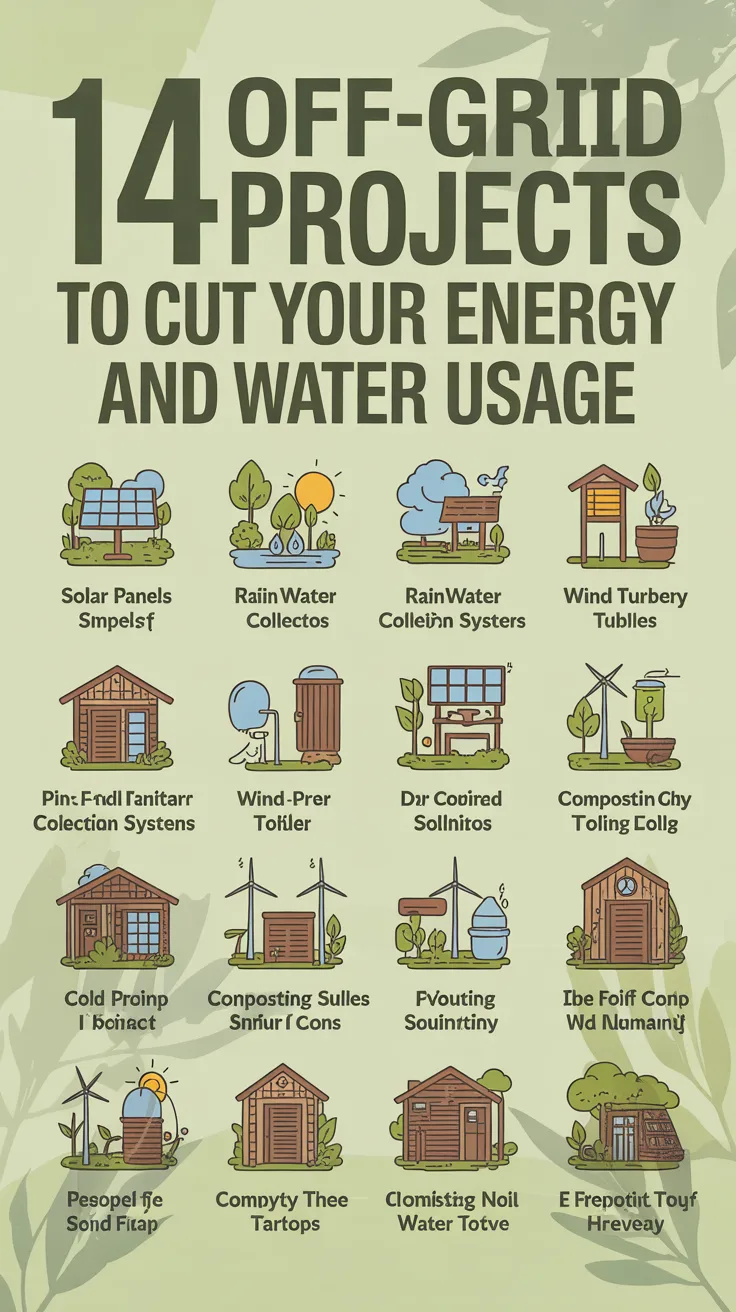
Want to spend less on utilities while building real resilience? These 14 off-grid projects to cut your energy and water usage are practical, scalable, and doable on weekends. From rainwater harvesting and gravity-fed filtration to plug-load slashing and passive heating/cooling, you’ll find low-cost wins and deeper upgrades that work whether you rent an apartment or own a homestead.
If you’re especially focused on water independence, a compact, gravity-powered system like the Aqua Tower can turn stored or collected water into clean, drinkable supply without electricity—ideal as a stand-alone solution or paired with rain capture.
Table of Contents
Fast wins from 14 off-grid projects to cut your energy and water usage
Small changes compound. These quick-start projects can cut utility bills this month and lay a foundation for bigger off-grid moves.
Project 1: Home energy and water baseline challenge
Before you can cut, you need a baseline. Spend one week logging daily electric meter readings (morning/night) and your water meter or monthly bill. Build a simple spreadsheet with:
- kWh per day weekdays vs. weekends
- Gallons per person per day
- Notes on big-use events (laundry, dishwasher, long showers)
Why it works:
- You’ll see “phantom” spikes (plug loads, always-on gadgets).
- You can forecast payback for other upgrades (e.g., a solar water preheater).
- Baselines create motivation; you’ll typically cut 5–10% just by tracking.
Project 2: Aerators, showerheads, and the stealth leak hunt
Install high-quality faucet aerators (0.5–1.0 gpm on sinks) and an efficient showerhead (1.5–1.8 gpm with good spray). Then do a leak hunt:
- Food coloring test in toilet tanks (dye in tank, wait—color in bowl means flapper leak).
- Check under-sink traps and hose bibs.
- Inspect irrigation lines and hose connections.
Why it works:
- Aerators often cut sink water use 30–60% without changing experience.
- Efficient showerheads save hot water, reducing both water and energy.
- A single leaky toilet flapper can waste hundreds of gallons daily.
Light, plug loads, and micro solar that pay back fast
Lighting and “always-on” electronics waste more than you think. Pair efficient fixes with a small solar kit to power essentials when the grid blinks.
Project 3: LED retrofit and lighting zones
Replace remaining incandescents/CFLs with quality LEDs (2700–3000K for warm rooms, 4000–5000K for task areas). Create “lighting zones”:
- Task lights at desks and kitchen prep areas
- Motion sensors in closets, garages, pantries
- Dimmer circuits where ambient light varies
Why it works:
- LEDs cut lighting energy by 75–85% vs. incandescent.
- Zoning reduces how often whole-room lights are used.
- Motion sensors eliminate “left on” waste.
Project 4: Smart strips, timers, and a 200–400W balcony/shed solar kit
Phantom loads add up. Use smart strips and timers for:
- Entertainment centers (TV, consoles, amp)
- Office zones (monitor, speakers, printer)
- Coffee maker and counter appliances
Add a 200–400W plug-and-play solar kit for a balcony or shed roof. Use it to run:
- Router and modem
- LED lighting string
- Device chargers
- A small 12V fridge or chest freezer (with careful sizing)
Why it works:
- Smart strips kill standby consumption.
- A micro solar kit softens your grid draw and builds off-grid skills you’ll use later for larger arrays.
Heat, insulation, and passive solar that move the needle
Heating typically dominates household energy. Tighten the envelope and harvest free heat before you spend on bigger systems.
Project 5: Weekend air-seal and attic insulation top-up
Focus on the biggest culprits:
- Air-seal attic penetrations (wires, plumbing vents) with fire-rated foam
- Weatherstrip exterior doors and attic hatch
- Seal rim joists with foam board + spray foam
- Add blown-in cellulose or batts to reach recommended R-value for your climate
Why it works:
- Air sealing can drop heating/cooling load 10–25%.
- Insulating the attic is high-ROI and very DIY-friendly.
- Warmer surfaces improve comfort at lower thermostat settings.
Project 6: DIY solar air heater or window box heater
Build a passive heater using a dark absorber (aluminum cans or corrugated metal), a glazed front, and a thermosiphon design:
- Mount on south-facing wall or window.
- Cool air enters low; sun warms the absorber; hot air exits high.
- No electricity required; just sunshine.
Why it works:
- Delivers free heat to a specific room or workshop.
- Reduces dependence on resistive space heaters.
- Extends shoulder seasons without firing up central heat.
Hot water independence and preheating for lower bills
Water heating is the second-largest energy use in many homes. Preheat with the sun and insulate everywhere hot water travels.
Project 7: Solar batch water heater (no pumps, no controllers)
A simple batch heater is essentially a dark tank in a glazed, insulated box:
- Install near your existing tank, or as a preheat loop.
- Cold water flows through the solar tank first; the main heater boosts only if needed.
- Angle toward the sun; add freeze protection strategies in colder climates.
Why it works:
- Preheating can cut your water heating energy 30–60% in sunny seasons.
- It’s cheap, robust, and purely passive.
Project 8: Insulation wraps and lower setpoints
If a heat pump water heater isn’t in the cards, do this:
- Insulate hot water tank (if it’s older and not already well-insulated).
- Wrap the first 6–10 feet of hot and cold pipes with foam sleeves.
- Install heat-trap nipples or check they’re present.
- Set tank to 120°F (49°C) for safety and savings.
Why it works:
- Standby losses drop significantly with insulation.
- Lower setpoints and shorter pipe runs reduce energy and time-to-hot-water.
Water independence projects to cut your energy and water usage
Harvest, store, and purify your own supply. These two projects create a rain-to-glass pathway that works on or off the grid.
Project 9: Rain barrel to IBC cistern with first-flush diverter
Start with a single barrel, then scale:
- Gutter screens keep out leaves.
- A first-flush diverter discards the dirtiest initial roof runoff.
- Feed storage into one or more 275–330 gallon IBC totes (opaque them to block light).
- Place tanks on a raised stand for gravity pressure; add hose bibs and an overflow to a garden swale.
Why it works:
- Even modest roof areas collect thousands of gallons a year.
- Gravity distribution means zero pump power for irrigation and chores.
- First-flush and screens keep tanks clean, lowering maintenance.
Project 10: Gravity-fed potable filtration station
Create a simple purification station for drinking and cooking water:
- Pre-filter with a sediment filter sock or bag.
- Gravity filter through ceramic/carbon elements or a multi-stage gravity box.
- Store finished water in food-grade containers, in the dark, with rotation.
If you prefer an all-in-one, the SmartWaterBox is designed for off-grid gravity filtration—no power required. For households focused on turnkey, family-ready solutions, the Aqua Tower provides a compact, high-capacity pathway from stored or collected water to clean drinking supply. If you have shallow groundwater or a spring on your property, Joseph’s Well outlines approaches to accessing water with minimal or no grid power, complementing rain capture and filtration.
Why it works:
- Gravity does the pumping; you remain hydrated during outages.
- Multi-stage filtration improves taste and safety.
- Paired with rain capture, you’re insulated against service interruptions.
Greywater, composting, and circular reuse
Reduce potable demand by reusing water where it counts most and turning waste into resources.
Project 11: Laundry-to-landscape greywater loop
Divert washing machine discharge to the yard (where legal):
- Use a 3-way diverter valve to send water to either sewer/septic or mulch basins.
- Only use plant-safe detergents; avoid bleach and borax.
- Distribute through a simple 1-inch line to multiple basins near trees or shrubs.
Why it works:
- Reuses 15–40 gallons per wash load directly in the landscape.
- Reduces irrigation needs and municipal/septic load.
- Minimal elevation change and no pumps needed in most homes.
Project 12: Composting toilet or urine diversion
Traditional toilets send drinking water down the drain. Alternatives:
- Self-contained composting units for cabins or workshops.
- Urine-diverting seats reduce moisture and odor; compost solids separately per local codes.
- For RVs/tiny homes, compact separating toilets eliminate blackwater entirely.
Why it works:
- Slashes indoor water use dramatically.
- Cuts septic stress or sewer usage fees.
- Provides nutrient cycles when compliant with local regulations and composting best practices.
Resilient power and passive cooling for comfort off-grid
When the grid falters, the right mix of storage and airflow keeps essentials running and the home comfortable.
Project 13: 12V battery bank with inverter for critical loads
Build a basic energy hub:
- Two to four deep-cycle batteries or a LiFePO4 module, fused and bus-barred.
- A pure sine wave inverter sized for your essentials (router, lights, phone charging, laptop, CPAP).
- DC circuits for ultra-efficient 12V/24V loads (LED strips, fans, fridge).
- Optional: integrate with your micro solar kit for charging.
Why it works:
- Keeps communication, lighting, and niche appliances running during outages.
- Lets you shift some daily use off-grid even when the grid is up.
- DC-first thinking reduces conversion losses.
Project 14: Passive cooling stack—attic ventilation and night flushing
Create a cooling plan that doesn’t rely on AC:
- Solar attic fan + ridge/soffit vents to purge roof heat.
- Thermal curtains, exterior shade sails, and deciduous plantings on west/south facades.
- Night purge: open high and low windows after sunset to flush heat; close and shade by mid-morning.
- Add ceiling fans and a whole-house fan where climate-appropriate.
Why it works:
- Attic heat can reach 130–150°F; venting slashes heat gain into living space.
- Night flushing leverages diurnal swings for comfort.
- Fans use a fraction of the energy of compressor-based cooling.
Tools and resources that accelerate your build-out
If you’re prioritizing water self-reliance, pair your rain capture and storage with proven gravity solutions:
- Aqua Tower: Compact, family-ready gravity system for turning stored or collected water into clean drinking supply without power.
- SmartWaterBox: Off-grid gravity filtration box for multi-stage purification.
- Joseph’s Well: Approaches to accessing groundwater with minimal dependence on grid power—useful where rain is seasonal or limited.
For broader household resilience beyond utilities, pantry depth matters. A reference like The Lost SuperFoods explores low-energy food storage and preparation ideas that complement your off-grid water and energy setup.
How these 14 off-grid projects cut your energy and water usage in the real world
Each project chips away at demand or supplies vital resources without the grid:
- Baseline tracking, aerators, and leak fixes: immediate reductions in daily gallons and kWh.
- LED lighting, smart strips, and envelope improvements: lower baseload and peak heating/cooling needs.
- Solar batch preheat and pipe insulation: tangible cut to water-heating energy.
- Rain capture + gravity filtration: displaces municipal water for irrigation and drinking.
- Greywater and composting: slashes potable demand and wastewater output.
- Battery bank + passive cooling: resilience for outages and less reliance on HVAC.
Adopt them incrementally. Start with free changes (tracking, leak fixes), move to low-cost upgrades (aerators, LEDs, weatherstripping), then step into capital projects (rain storage, filtration, insulation) and finally system-level shifts (battery bank, solar preheat, greywater, composting). The compounding effect lowers bills, increases comfort, and builds the confidence to tackle larger off-grid ambitions.
Conclusion
This list of 14 off-grid projects to cut your energy and water usage is more than a collection of DIYs—it’s a roadmap to lower bills, higher comfort, and genuine resilience. Begin where you are, invest where the payback is obvious, and layer in water independence to insulate your home from supply shocks. As you stack these projects, you’ll notice the grid mattering less, and your home doing more with less.
FAQ
What should I start with if I have only one weekend?
Begin with the baseline challenge, aerators/showerhead swap, and a leak hunt. You’ll likely see immediate drops in both water and energy use, setting you up for bigger wins later.Are rainwater harvesting and greywater systems legal everywhere?
No. Regulations vary by state/country and sometimes by municipality. Check local codes for rain catchment, storage sizing, backflow prevention, and greywater use. Many areas allow laundry-to-landscape systems with simple guidelines.Do these 14 off-grid projects to cut your energy and water usage work for renters?
Yes—choose portable and reversible options: LED bulbs, smart strips, window air-sealing kits, faucet aerators, showerheads, balcony solar kits, and freestanding gravity filters like the Aqua Tower or SmartWaterBox. For rain capture, consider standalone barrels that don’t require structural changes (if allowed by your lease).How much water can I realistically supply off-grid with rain capture?
A rule of thumb is 0.62 gallons per square foot of roof per inch of rain. A 1,000 sq ft roof in a 30-inch/year climate could harvest ~18,600 gallons annually, less losses. With efficient fixtures, greywater reuse, and garden-friendly practices, this covers a significant portion of household needs.How do I ensure safe drinking water from my system?
Use a multi-barrier approach: roof screening and first-flush, storage in opaque food-grade tanks, and gravity-fed multi-stage filtration for drinking/cooking water. Keep raw and finished water containers separate, rotate stored potable water, and maintain filters per manufacturer guidance.What about winter and freezing?
Insulate exposed pipes and taps, bury lines below frost depth when possible, and use freeze-proof valves. For batch solar heaters in cold climates, consider drainback designs or seasonal operation. Keep rain storage lines drainable and use dark, insulated housings to moderate temperature swings.Can these projects really lower my electricity bill without rooftop solar?
Yes. Air-sealing, insulation, LEDs, smart strips, passive heating/cooling, and water-heating tweaks often cut 20–40% with modest investment. Adding even a small balcony/shed solar kit plus a slim battery bank further offsets daily consumption and provides outage resilience.How do composting toilets affect odor and sanitation?
Quality units and proper operation control odor effectively. Urine diversion reduces moisture; adding bulking agents (e.g., sawdust) improves aeration. Follow local regulations for post-compost handling and never apply unfinished compost to food crops.