
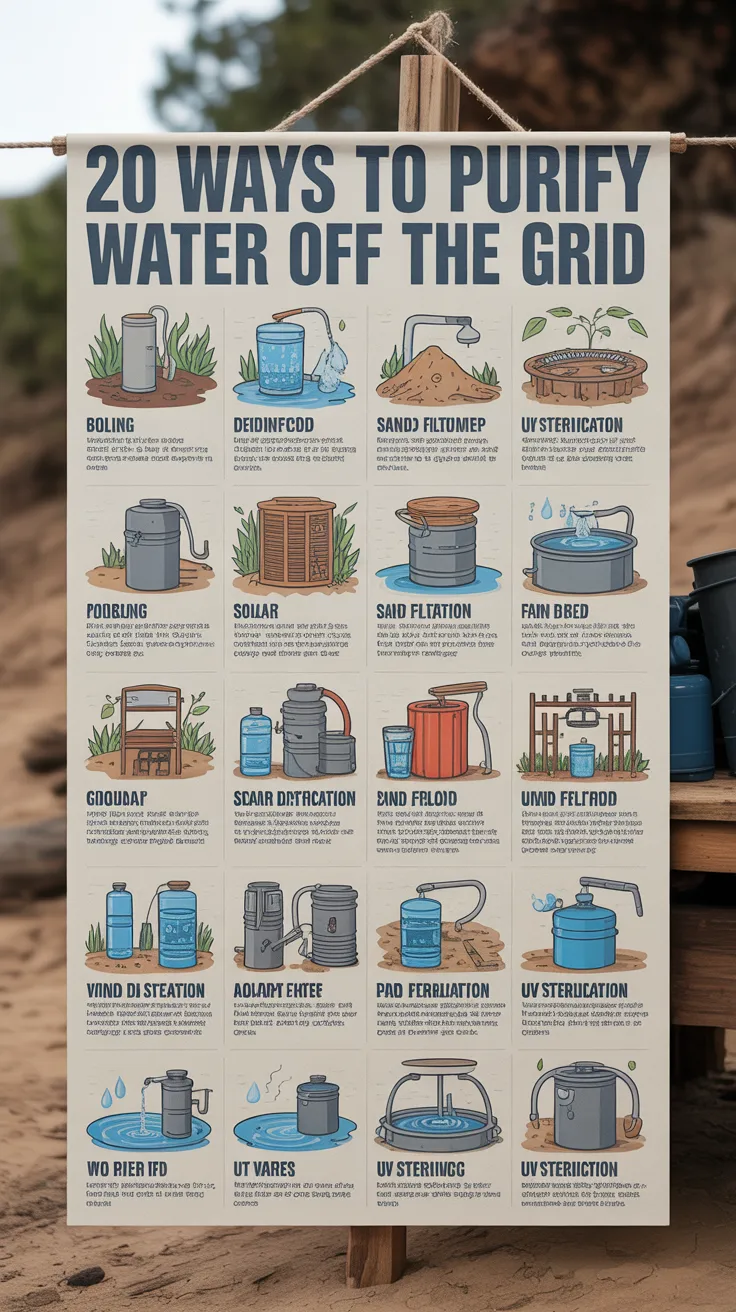
Staying hydrated off-grid isn’t negotiable—but safe water often is. Whether you’re homesteading, camping, or responding to a grid-down emergency, these 20 ways to purify water off the grid give you layered options for different sources and scenarios. You’ll learn when to use heat, chemicals, filters, UV, and phase-change methods, plus how to combine them for maximum safety.
If you want a reliable, low-maintenance household solution, a gravity-fed ceramic system like the Aqua Tower can deliver safe, great-tasting water without electricity—all you need is gravity and regular filter care.
Table of Contents
Mechanical pre-treatment that sets every method up for success
Before you disinfect or filter, get the big stuff out of your water. This “pre-treatment” step improves taste, speeds up filtration, and increases the effectiveness of chemical or UV methods.
- Pre-filtration and straining (Method 1)
- Sedimentation and flocculation (Method 2)
1) Pre-filtration and straining
Run turbid water through a clean cloth, coffee filter, or microfiber towel into a clean vessel. This removes leaves, grit, and visible particulates that can clog filters or shield microbes from disinfectants. For field improvisation, fold a tightly woven bandana into multiple layers. If water is extremely muddy, use a multi-stage improvised funnel with gravel on top, then sand, then cloth to trap larger sediments—this is not final purification, but it dramatically improves everything you do next.
2) Sedimentation and flocculation
Letting water sit undisturbed allows heavy particles to settle; carefully decant the clearer upper layer. Speed this up with flocculation: swirl the water vigorously, then add a pinch of fine wood ash (not charcoal briquettes) or use a natural coagulant like crushed moringa seeds. Wait 30–60 minutes. The particles clump (floc) and sink, leaving clearer water to treat. Always follow sedimentation with a real purification step (boiling, chemical, UV, or fine filtration).
Pro tip: Keep separate “dirty” and “clean” containers, with lids, to avoid cross-contamination. Label them, and never dip dirty scoops into clean water.
Heat-based purification that always works off-grid
Heat is dependable, fuel permitting. It inactivates bacteria, protozoa, and viruses—making it one of the most universal ways to purify water off the grid.
- Boiling (Method 3)
- Pasteurization (Method 4)
- Stone-boiling without cookware (Method 18)
3) Boiling
Bring water to a rolling boil (big, continuous bubbles) for at least 1 minute; at elevations above 2,000 meters (6,500 ft), boil for 3 minutes. Let it cool in a covered container. Boiling won’t remove chemicals, metals, or salts, but it’s a gold-standard for microbiological safety when the source is biologically suspect. If taste is flat, aerate by pouring between containers.
4) Pasteurization
Water doesn’t need to boil to be safe; pasteurization inactivates pathogens at temperatures lower than 100°C if held long enough. Using a Water Pasteurization Indicator (WAPI) or a thermometer, heat water to about 65–70°C (149–158°F) until the indicator confirms target temperature. This saves fuel and is great with solar ovens or efficient biomass stoves. As with boiling, pasteurized water needs clean handling post-treatment.
18) Stone-boiling when you don’t have a pot
No metal container? Heat egg-sized stones in a fire until very hot (avoid river stones with trapped moisture that can explode). Using tongs or green sticks, place stones into a wooden bowl, bark container, or thick-walled clay vessel of water. Rotate stones until the water reaches a rolling boil. This is slow and takes practice, but it makes boiling possible with minimal gear.
Chemical disinfection for portable and long-term storage
Chemicals can neutralize viruses (a key advantage over many filters) and are compact, lightweight, and ideal for kits and caches.
- Unscented household bleach (Method 5)
- Iodine (Method 6)
- Chlorine dioxide (Method 7)
5) Unscented household bleach
Use plain, unscented bleach (sodium hypochlorite). Dose depends on concentration; many household bleaches are 5–9%. A common guideline is a few drops per liter; stir, wait at least 30 minutes, and ensure a slight chlorine smell. If there’s no smell, add a similar dose and wait another 15 minutes. Follow up with activated carbon to improve taste. Always check the label, avoid splashless/scented products, and follow health-agency guidance for concentrations and dosages.
6) Iodine
Iodine tablets or tincture are compact and effective against bacteria and viruses, but they’re less effective against some protozoa and can affect taste. They’re not recommended for pregnant people, those with thyroid conditions, or long-term daily use. Observe the manufacturer’s contact time and dosage, and use a carbon filter afterward if taste is an issue.
7) Chlorine dioxide
Chlorine dioxide tablets or two-part drops are highly effective against bacteria, viruses, and protozoa (including giardia). Crypto requires longer contact times—often up to 4 hours in very cold/turbid water—so plan ahead. As with other chemicals, protect treated water from re-contamination and consider carbon post-filtration for taste.
Tip: Chemical disinfection works best in clear water. If the source is cloudy, pre-filter or let sediments settle first.
Filtration that removes pathogens and improves taste
Physical filtration traps organisms and particles; pairing it with disinfection covers more threats. This category includes everything from simple carbon to robust, no-electricity gravity systems—some of the most practical ways to purify water off the grid for day-to-day use.
- Activated carbon (Method 8)
- Ceramic gravity filtration (Method 9)
- Hollow fiber microfiltration (Method 10)
8) Activated carbon
Carbon absorbs many organic compounds, improves taste and odor, and reduces some chemicals. It does not reliably remove viruses and should be paired with microfiltration or disinfection. Use as a stage in a multi-layer setup to polish water after harsh treatments like bleach.
9) Ceramic gravity filtration
Ceramic elements with tiny pores physically remove bacteria and protozoa as water passes through by gravity. They require no power, are easy to maintain (you scrub the outer surface to restore flow), and can pair with carbon for taste. For a dependable household unit you can run off-grid indefinitely, consider a gravity system like the Aqua Tower; keep extra elements and clean them per instructions.
10) Hollow fiber microfiltration
Hollow fiber membranes (straw, squeeze, or pump filters) commonly filter to 0.1–0.2 microns, removing bacteria and protozoa. They’re fast and light but typically don’t remove viruses. Backflush regularly to maintain flow. Combine with chemical treatment if viral risk is possible (heavily populated areas, sewage contamination).
Looking for a compact, multi-stage option for cabins or bug-out kits? A small off-grid filtration box that stacks sediment, carbon, and fine filtration—like SmartWaterBox—can give you flexibility with changing water sources without needing power.
DIY multi-stage filters you can build from common materials
When supply chains are down or budgets are tight, DIY filters offer robust performance, especially when you combine them with a final disinfection step.
- Biosand filter (Method 11)
- Slow sand filter (Method 12)
- DIY bottle multi-media filter (Method 13)
11) Biosand filter
A biosand filter is a small household unit built from a container filled with layers of sand and gravel, with a “biolayer” forming at the top over time. As water moves slowly through, it’s physically filtered and biologically treated, reducing microbes and turbidity. Biosand units shine in daily use for families. Build carefully to specs (correct sand size, flow rate, diffuser plate), and keep a lid on to protect the biolayer. Pair with boiling or chemical disinfection when sources are high-risk for viruses.
12) Slow sand filter
Larger than biosand, slow sand filters run at very low rates across fine sand, developing a schmutzdecke (biological layer) that consumes pathogens. They’re widely used in municipal systems and can be scaled for homesteads. They require space and periodic maintenance (scraping the top layer). As with biosand, treat virus risk separately with UV or chemicals.
13) DIY bottle multi-media filter
In a pinch, make a simple gravity filter: cut the bottom off a bottle, invert it, and layer cloth, fine sand, charcoal (crushed from hardwood and rinsed), and gravel. This removes turbidity and some contaminants. It’s not a stand-alone purifier—finish with boiling, chemicals, or UV. Replace and rinse media frequently to avoid bacterial growth.
Maintenance matters: Label your filters with build dates, track flow rates (declining flow can indicate clogging), and avoid touching clean media with dirty hands or tools.
Sunlight and UV methods that save fuel
The sun gives you free energy. With clear bottles and patience—or a compact UV device—you can neutralize microbes with no fuel.
- Solar disinfection (SODIS) (Method 14)
- UV light purifiers (Method 15)
- Solar still for distillation (Method 16)
14) Solar disinfection (SODIS)
Fill clear PET bottles (not glass, not opaque) with clear water, shake to oxygenate, and lay them horizontally on reflective surfaces in full sun for at least 6 hours (or 2 days under heavy clouds). UV-A and heat work together to inactivate pathogens. SODIS is great for small volumes and sunny climates; avoid very turbid water and replace scratched bottles. It’s simple, sustainable, and perfect as a backup in your purification toolkit.
15) UV light purifiers
Handheld UV purifiers treat small quantities quickly by stirring the UV lamp in the water for the prescribed time. They’re effective against bacteria, protozoa, and viruses—assuming the water is clear (pre-filter if needed). Bring spare batteries or a way to recharge off-grid. As with chemicals, UV doesn’t remove chemicals or sediments, so consider adding carbon or a fine filter for taste and clarity.
16) Solar still distillation
A solar still uses the sun to evaporate water and condense it on a cool surface, leaving salts and many contaminants behind. Dig a pit, place a clean collection cup in the center, lay plastic sheeting over the top, and weight the center so condensed droplets run into the cup. This yields very small volumes—better as a survival technique than a daily household method—but it’s invaluable if you’re stuck with brackish water.
Phase-change and advanced systems for tough water
When the source includes salts, heavy metals, or chemical contamination—as with brackish wells or post-flood water—you need methods beyond basic filtration.
- Distillation (stove/pot) (Method 17)
- Stone-boiling already covered; add reverse osmosis (Method 19)
- Combining methods for redundancy
17) Distillation (pot and condenser)
Boil water and capture steam, then condense it into a clean container using a coiled tube or improvised lid-and-drip setup. Distillation removes salts, many heavy metals, and microbes. Some volatile chemicals can co-distill, so use a carbon post-filter if you suspect solvents or fuel contamination. It’s fuel-intensive but reliable for “impossible” sources, from seawater to contaminated wells.
19) Reverse osmosis (RO) with off-grid pressure
RO forces water through a semi-permeable membrane, removing salts, metals, and microbes. It needs pressure; off-grid options include hand pumps, gravity head (limited), pressurized tanks, or solar-powered pumps. RO produces a brine waste stream, so plan for disposal and pre-filter to protect the membrane. For cabins with brackish water, an RO unit with a manual or solar pump can be a game-changer.
Layering for safety: In high-risk scenarios, combine approaches—e.g., sedimentation → hollow fiber → chlorine dioxide → carbon—for robust multi-barrier treatment.
Sustainable off-grid water sourcing and daily operations
Purification’s only half the equation—consistent sourcing and smart handling keep you supplied.
- Rainwater harvesting with first flush (Method 20)
- Groundwater access and treatment
- Safe storage and distribution
20) Rainwater harvesting with first-flush and treatment
Roof catchment can supply abundant water in many climates. Use food-grade gutters and tanks, install screens to block debris, and add a first-flush diverter to discard the initial dirty runoff each rainfall. Store in opaque, covered tanks to minimize algae, and treat before drinking: run through filtration (ceramic or hollow fiber), polish with carbon, and disinfect (boil, UV, or chemicals). Always protect “clean” taps from contamination.
Groundwater access, off-grid: If you can reach a shallow aquifer, a manual system helps you pump without electricity. A solution like Joseph’s Well can help you access groundwater off-grid; pair it with downstream filtration or disinfection per the methods above. Test well water periodically for chemicals and bacteria, especially after floods or earthquakes.
Safe storage matters: Use dedicated, food-grade containers with tight lids, label fill/treatment dates, and keep them off concrete floors on pallets in cool, dark spaces. Treat distribution as part of purification—clean spigots, no hand-dipping, and use a small dose of residual disinfectant if storing for weeks.
Recommended off-grid water tools and resources
- Aqua Tower: Gravity-fed ceramic filtration for daily, no-electricity household use. Simple to maintain; great-tasting water.
- SmartWaterBox: Compact multi-stage filtration you can deploy in cabins, RVs, or as a backup kit.
- Joseph’s Well: Off-grid groundwater access you can combine with purification for year-round resilience.
- The Lost SuperFoods: A preparedness compendium with preservation and storage ideas that pair well with water planning.
Building your off-grid water plan step by step
A resilient plan stacks methods. Start with what you’ll use daily (e.g., a gravity filter with carbon), then add a virus-capable backup (UV or chlorine dioxide), and a heavy-duty option for chemical/brackish sources (distillation or RO). Pre-stage fuel for boiling and pasteurization, and train on at least one DIY filter as a fall-back. Finally, rehearse safe storage and distribution to prevent recontamination.
If you’re setting up a home base or homestead, a reliable gravity system like the Aqua Tower for everyday use, paired with a compact backup like SmartWaterBox and a manual groundwater option like Joseph’s Well, covers most scenarios without relying on the grid.
Conclusion
You now have 20 ways to purify water off the grid, from simple cloth pre-filters and boiling to UV, ceramic gravity systems, and advanced RO or distillation. No single method fits every source, so think in layers: clear the water, filter it, disinfect it, and store it safely. Start with one dependable daily option, add a virus-capable backup, and keep a high-power solution for worst-case contamination. With a little practice and the right tools, safe water off-grid becomes routine—not risky.
FAQ
What is the safest universal method to purify water off the grid?
Boiling is universally effective against microbes when done correctly (1 minute rolling boil; 3 minutes at high elevation). For chemical or salty contamination, use distillation or reverse osmosis.How can I purify very cloudy water before chemical treatment?
Use pre-filtration (cloth), then sedimentation and flocculation to clear it. Once it’s visibly clearer, use your chosen disinfectant (bleach, iodine, chlorine dioxide) and consider a carbon stage for taste.Which off-grid method removes viruses without chemicals?
UV methods do (SODIS and handheld UV purifiers), provided the water is clear. Many filters don’t remove viruses unless they’re rated for ultrafiltration; pair microfilters with UV or chemicals for viral protection.What’s the best off-grid setup for a small homestead?
A layered system: rainwater harvesting with first flush, a gravity-fed ceramic filter for daily use, carbon for taste, and a backup UV or chlorine dioxide for viral protection. Keep a distiller or RO option if your source can be brackish or contaminated.Can I rely on solar stills or transpiration for daily drinking water?
Solar stills and plant transpiration bags produce very small amounts—great as survival techniques but not daily drivers. Use them as a backup while you implement higher-output methods like gravity filtration and rainwater collection.