
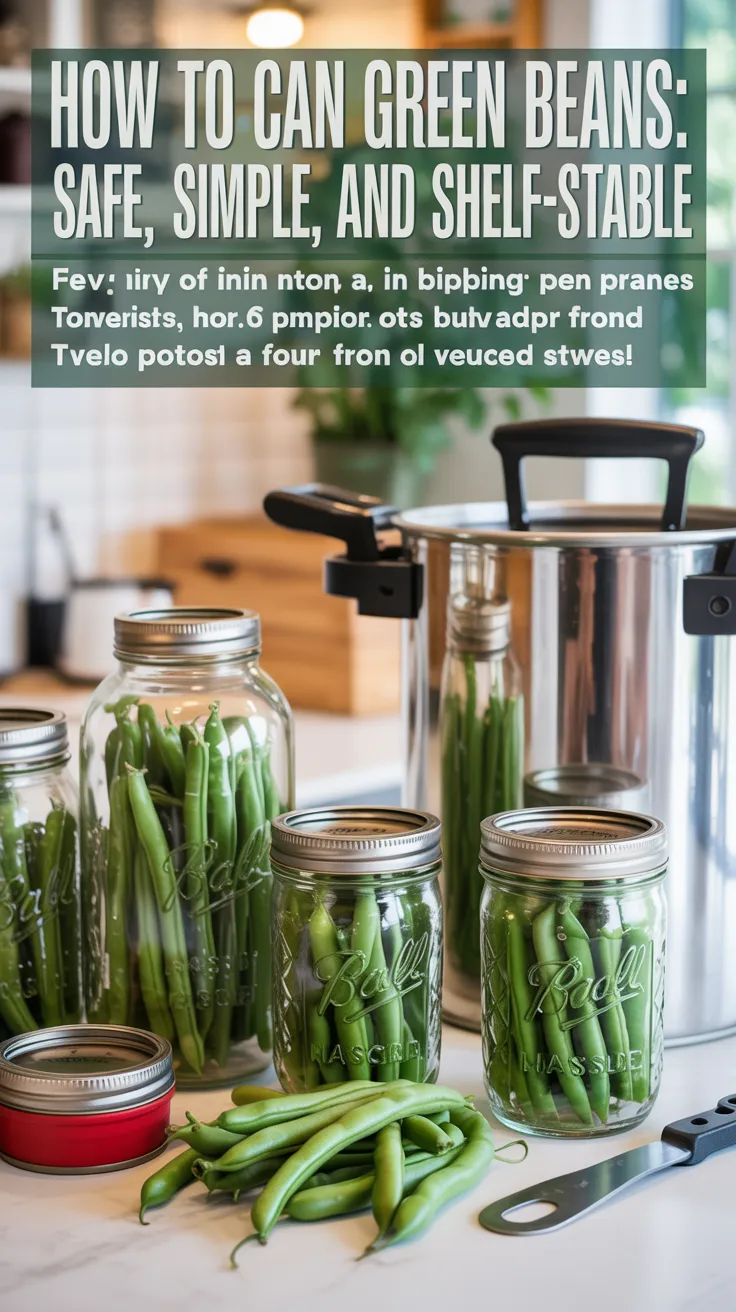
Canning is one of the most rewarding ways to preserve a bumper crop, and once you learn how to can green beans safely, you’ll have crisp-tender jars ready for soups, casseroles, stir-fries, or quick sides all year long. Because green beans are a low-acid vegetable, they must be pressure canned—never water-bath canned—to prevent the risk of botulism. This guide covers equipment, step-by-step technique, altitude adjustments, and troubleshooting so your pantry fills up with reliable, delicious results.
If you’re building a long-term food storage plan, you’ll also enjoy the creative pantry strategies inside The Lost SuperFoods, a resource packed with heritage preservation ideas that pair well with home canning.
Note: This article contains affiliate links. If you click and purchase, we may earn a commission at no extra cost to you.
Table of Contents
Essential gear and ingredients for canning green beans
Home canning is straightforward when you have the right tools. For green beans, a pressure canner is non-negotiable. A boiling water bath simply can’t reach temperatures high enough to make low-acid vegetables safe.
Core gear checklist:
- Pressure canner with either a dial gauge or a weighted gauge
- Mason jars (pints or quarts), with new lids and clean rings
- Jar lifter, canning funnel, bubble remover (plastic spatula or chopstick works), magnetic lid wand
- Clean cloths or paper towels
- Large pot for boiling water (packing liquid)
- Cutting board and knife
- Timer
- White vinegar for wiping rims and reducing mineral film in canner water
Ingredients:
- Fresh, tender green beans (snap beans, string beans, Italian/romano, or fillet beans)
- Water (for the jars and the canner)
- Canning/pickling salt, optional (flavor only): use 1/2 teaspoon per pint or 1 teaspoon per quart if desired
Jars and yield tips:
- One pound of whole green beans yields roughly one pint jar when trimmed and cut.
- Choose beans that are crisp and free of rust spots or bulging seeds. Overmature beans lead to tough results.
- Plan for 2–3 inches of water in the bottom of the pressure canner (check your manufacturer’s manual), plus a separate pot of boiling water for hot pack liquid if you choose that method.
About water quality:
- Hard water can cloud jar liquid. Add 1–2 tablespoons of white vinegar to the canner water to reduce mineral deposits.
- If your tap water tastes off or is heavily chlorinated, use filtered water for packing liquid to preserve clean flavor. For reliable filtration in the kitchen and as part of a resilient household setup, consider SmartWaterBox, which can improve the taste and clarity of your canning water and everyday drinking water.
Hot pack vs raw pack for canning green beans
You have two safe, tested options for packing green beans into jars: hot pack and raw pack. Both are pressure canned for the same times, but each method has its own advantages.
Hot pack (preferred for best quality):
- Prep: Wash beans thoroughly in cool water. Snap off stem ends, remove strings if present, and cut into 1–2 inch pieces (or leave whole if slender).
- Blanch: Boil beans for about 5 minutes in a large pot, then keep them hot.
- Pack: Fill hot jars with hot beans and cover with the bean cooking liquid or fresh boiling water, leaving 1 inch headspace.
- Benefits: Hot pack reduces air in the food, helps prevent floating beans, minimizes siphoning (liquid loss during processing), and improves final texture.
Raw pack (fastest prep, slightly more variable jar fill):
- Prep: Wash, trim, and cut beans as above, but don’t pre-cook.
- Pack: Tightly pack raw beans into hot jars and cover with boiling water, leaving 1 inch headspace.
- Notes: Raw-packed beans can trap more air, leading to more floating and potential liquid loss. Still safe when properly pressure canned.
Salt is optional:
- Canning/pickling salt adds flavor but does not affect safety. Avoid table salt (anti-caking agents can cloud jars) and flavored or iodized salts.
Headspace and de-bubbling:
- Maintain a strict 1 inch headspace from the top rim of the jar to the food/liquid level.
- Slide a bubble wand or plastic spatula down the sides to release hidden air pockets, especially with raw pack.
- After de-bubbling, re-check headspace and top off with more hot liquid if needed.
Choosing your method:
- If you prefer a firmer texture with less float and more consistent jar fill, choose hot pack. If speed is your priority and you’re comfortable with a bit more variability, raw pack works, too. In both cases, follow pressure canning times exactly.
Load jars like a pro: packing, headspace, and liquid
The packing stage sets you up for strong seals, clear liquid, and even heating during processing.
Step-by-step jar prep:
- Wash jars, lids, and rings in hot, soapy water. Rinse well. Keep jars hot until use (in a 180°F/82°C water bath, a 200°F/93°C oven, or your dishwasher’s hot cycle). Hot jars reduce temperature shock when adding boiling liquid.
- Simmer new lids per manufacturer’s instructions or keep them at room temperature if they’re designed for dry placement. Don’t boil modern lids unless the brand specifically directs.
Filling the jars:
- Use a canning funnel to keep rims clean.
- Pack prepared beans into hot jars. For raw pack, pack beans snugly; for hot pack, fill with hot beans without crushing.
- Pour boiling water (or bean blanching liquid for hot pack) over the beans, leaving 1 inch headspace.
- Remove air bubbles and adjust headspace. A precise 1 inch is essential for safe processing and proper vacuum formation.
- Optional: Add salt—1/2 tsp per pint or 1 tsp per quart—before adding liquid for even distribution.
Wipe and cap:
- Wipe rims with a cloth dipped in vinegar to remove oils and residues that can interfere with sealing.
- Place lids on jars and add rings. Tighten to fingertip-tight—snug, but not cranked down.
Loading the pressure canner:
- Add 2–3 inches of water to your canner (check your model’s manual).
- Place the canner rack, then load jars upright with space between them for steam circulation.
- Secure the lid according to the manufacturer’s instructions, but leave the weight off the vent (or the petcock open) to allow steam to vent initially.
Mid-process note on water quality:
- If your water is very hard, a small splash of vinegar in the canner helps keep jar exteriors free of mineral film. For a simple, kitchen-friendly filtration solution that supports great-tasting canning liquid, SmartWaterBox is a convenient upgrade.
How to can green beans with a pressure canner: venting, PSI, and timing
This is the critical safety step. Processing times and pressures are non-negotiable for green beans.
Venting:
- Heat the canner on medium-high. When a robust column of steam vents from the spout, set a timer for 10 full minutes. Venting purges air, ensuring the canner reaches true sterilizing temperatures.
Pressurizing:
- After 10 minutes of steady venting, add the weight or close the petcock. The canner will come to pressure over a few minutes. Start your processing time only when the gauge reads target pressure or the weight begins its correct jiggle cadence.
Processing times:
- Pints: 20 minutes
- Quarts: 25 minutes
Pressure targets (sea level to 1,000 feet):
- Dial-gauge canner: 11 pounds of pressure (PSI)
- Weighted-gauge canner: 10 PSI
Altitude adjustments:
- Dial gauge:
- 0–2,000 ft: 11 PSI
- 2,001–4,000 ft: 12 PSI
- 4,001–6,000 ft: 13 PSI
- 6,001–8,000 ft: 14 PSI
- Weighted gauge:
- 0–1,000 ft: 10 PSI
- Above 1,000 ft: 15 PSI
Check your local elevation before you begin. Higher altitudes require higher pressure to maintain safe temperatures.
Maintaining pressure:
- Adjust heat so the dial holds steady or the weight jiggles per your manual (often 1–4 jiggles per minute, depending on brand). Avoid pressure drops; if pressure falls below target, bring it back up and restart the timing from the beginning.
End of processing:
- When the time is up, turn off the heat. Do not move or force-cool the canner. Natural cool-down preserves liquid in jars and prevents siphoning.
Safety reminders:
- Never water-bath can green beans. They are low-acid and require the higher temperatures only a pressure canner can achieve.
- Never thicken, puree, or add dairy or fat before canning—these changes affect heat penetration and safety. Save thickeners and fats for serving day.
Cool-down, sealing, and storage for shelf-stable beans
Cooling properly is as important as the processing itself. Rushing this part can cause liquid loss, seal failure, and texture problems.
Depressurizing:
- Let pressure drop naturally to zero. Wait an additional 5–10 minutes after reaching zero before opening the vent or removing the weight.
- Unlock the lid away from your face to avoid steam burns.
Removing jars:
- Use a jar lifter to transfer jars to a draft-free area lined with a towel or cooling rack. Keep jars upright; don’t tilt to pour off liquid.
- Leave 1–2 inches of space between jars for even cooling. Do not re-tighten rings or press lids at this point.
Sealing:
- Within minutes, you’ll often hear the “ping” of lids sealing. Let jars cool undisturbed for 12–24 hours.
- After cooling, remove the rings. Test seals by pressing the center of each lid—no flex means sealed. Gently lift jars by the edges of the lid only if you’re confident; the safer check is visual and tactile.
Cleanup and labeling:
- Wipe jars with a damp cloth. If residue or mineral film remains, a little vinegar helps.
- Label each jar with contents and date (e.g., “Green Beans, Hot Pack, Pints, 2026-08”).
Storage:
- Store sealed jars in a cool, dark place (50–70°F/10–21°C). Avoid direct sunlight and temperature swings.
- Best quality within 12–18 months, though safely processed jars can last longer. Discard if any spoilage signs appear.
Before opening and serving:
- Always inspect. If you notice an unsealed lid, spurting liquid, off-odors, mold, or unusual cloudiness, discard the jar contents without tasting. When in doubt, throw it out.
Safety, altitude adjustments, and common fixes
Green beans are simple to can once you respect a few safety and quality rules. Here’s how to avoid pitfalls and fix issues when they arise.
Botulism and why pressure matters:
- Clostridium botulinum spores survive boiling temperatures. Only the higher heat of pressure canning reliably destroys them in low-acid foods like beans.
- Do not attempt to “acidify” plain green beans with lemon/vinegar and then water-bath them. If you want pickled beans, use a tested pickling recipe designed for water-bath canning.
Altitude recalibration:
- If you’re above 1,000 feet, you must adjust pressure upward (see the altitude chart earlier). Time stays the same; pressure changes.
Common issues and solutions:
- Siphoning (liquid loss): Often caused by inadequate venting, rapid pressure changes, or forced cooling. Vent fully for 10 minutes, avoid fiddling with heat, and never force-cool the canner.
- Floating beans: More common with raw pack. Choose hot pack next time or pack raw beans more tightly. Floating does not affect safety if jars are sealed.
- Cloudy liquid: May be from hard water or table salt. Use canning salt and filtered water; add a splash of vinegar to canner water. Spoilage cloudiness usually accompanies off-odors—discard if in doubt.
- Flat sour (off flavor, no visible spoilage): Can occur with slow cooling of starchy foods. With beans it’s uncommon; ensure prompt, natural cool-down and store jars in a cool place.
- Failed seals: If a lid doesn’t seal within 24 hours, refrigerate immediately and use within 3–4 days, or reprocess within 24 hours with a new lid (repeat full processing time). Investigate causes: chipped rims, debris on rims, over/under-tightened rings, or insufficient headspace.
Dial vs weighted gauges:
- Check dial gauges annually for accuracy (your local extension office often offers testing). Replace faulty gauges.
- Weighted gauges are self-regulating—listen for the correct jiggle pattern and maintain steady heat.
Quality tips:
- Choose young, tender beans; overgrown pods become tough during canning.
- Hot pack produces superior texture and fewer trapped air pockets.
- Keep headspace consistent across jars for even seals and minimal siphoning.
Make the most of your jars: serving ideas and pantry rotation
Your shelves are lined with gorgeous jars—now what? Having a rotation plan and a few go-to uses makes those jars even more valuable.
Simple uses:
- Heat and season as a quick side: a pat of butter or olive oil, a sprinkle of garlic powder, salt, and pepper.
- Toss into skillet meals: sauté onion and bacon, add drained beans and a splash of broth, simmer until flavors meld.
- Fold into casseroles and soups: from green bean casserole to minestrone, canned beans are weeknight gold.
- Stir-fries and salads: drain well and add late in cooking to keep texture. Chill, then dress with vinaigrette for a speedy salad.
Pantry rotation:
- First in, first out (FIFO): keep newest jars at the back and use older ones first.
- Track what you truly use: if you always reach for pints, can fewer quarts next season (or vice versa).
- Aim to can what you’ll eat in 12–18 months for best quality.
Flavor boosters on serving day:
- Add aromatics (garlic, shallot), citrus zest, or herbs (thyme, dill).
- For a smoky angle, finish with paprika or a dash of liquid smoke in the pan—after opening, not during canning.
Preparedness mindset:
- Green beans are a versatile, nutrient-dense staple in a resilient pantry. Pair your jars with shelf-stable stocks, grains, and tomato products, and you can build full meals without a grocery run.
If you’re mapping out smarter pantry planning for uncertain times or urban constraints, the streamlined strategies inside URBAN Survival Code can complement your canning know-how with practical, space-conscious resilience tactics.
Pantry rotation and preparedness boosters that complement canning
Home canning shines brightest when it’s part of a larger, thoughtful kitchen system. Alongside learning how to can green beans, consider a few tools and resources that support food quality, safety, and self-reliance. These are not required for canning success, but they can meaningfully enhance your setup.
- The Lost SuperFoods: Explore heritage preservation ideas and time-tested pantry strategies that pair beautifully with home canning. It’s an inspiring reference if you want to broaden beyond basic recipes and build reliable, diversified food storage. The Lost SuperFoods
- SmartWaterBox: Clean, good-tasting water improves your canning liquid, reduces off-flavors, and supports everyday hydration. A countertop or under-sink filtration upgrade is a simple win for both quality and peace of mind. SmartWaterBox
- Aqua Tower: For households focused on preparedness, having a gravity-fed filtration option can keep your kitchen running smoothly during outages and emergencies—and still provide clear water for cooking and canning prep. Aqua Tower
Use these resources as complements—not substitutes—for tested canning procedures. Your pressure canner remains the star; these tools simply support better flavor, safer water, and a stronger pantry system.
Conclusion: Confidently mastering how to can green beans
Once you understand the why and how behind pressure canning, learning how to can green beans becomes a repeatable, confidence-building kitchen skill. Choose fresh beans, decide on hot or raw pack, maintain 1 inch headspace, vent for 10 minutes, process at the correct PSI for your altitude (20 minutes for pints, 25 for quarts), and let the canner cool naturally. With those pillars in place, you’ll produce reliable seals, bright color, and great texture.
Fill your shelves at harvest time, rotate your stock, and use jars often in everyday meals. And if you’re expanding your pantry planning, check out complementary resources like The Lost SuperFoods, SmartWaterBox, and Aqua Tower to support quality and resilience across your kitchen.
FAQ
Do I need a pressure canner to can green beans?
Yes. Green beans are a low-acid vegetable and must be pressure canned to reach temperatures that destroy botulism spores. A boiling water bath is not safe for plain green beans.What is the difference between hot pack and raw pack for green beans?
Hot pack means blanching beans for about 5 minutes before packing them hot into jars and covering with hot liquid. It reduces floating and siphoning for better final quality. Raw pack skips the blanch step; you pack raw beans tightly and cover with boiling water. Both methods use the same pressure canning times.How long do you process jars when canning green beans?
Process pints for 20 minutes and quarts for 25 minutes at the correct pressure for your altitude. At up to 1,000 feet, use 11 PSI for dial-gauge canners or 10 PSI for weighted-gauge canners. Above 1,000 feet, weighted gauges use 15 PSI; dial gauges increase by altitude range.Can I water-bath can green beans if I add vinegar or lemon juice?
No—for plain beans. Adding acid at home isn’t the same as a tested pickled recipe. If you want pickled beans, follow a tested pickling formula intended for water-bath canning. Plain green beans require pressure canning.How long do home-canned green beans last, and how should I store them?
For best quality, use within 12–18 months. Store sealed jars in a cool, dark place, remove rings after sealing, and always inspect jars before opening. Discard any jar with an unsealed lid, spurting liquid, off-odors, or other spoilage signs.Why did my jars lose liquid during processing?
Likely causes include inadequate 10-minute venting, fluctuations in pressure, or force-cooling the canner. Vent thoroughly, keep pressure steady, and let the canner cool naturally to minimize siphoning.Is the salt necessary when canning green beans?
No. Salt is optional and only for flavor. Use canning/pickling salt to avoid cloudiness; skip it if you are reducing sodium.