
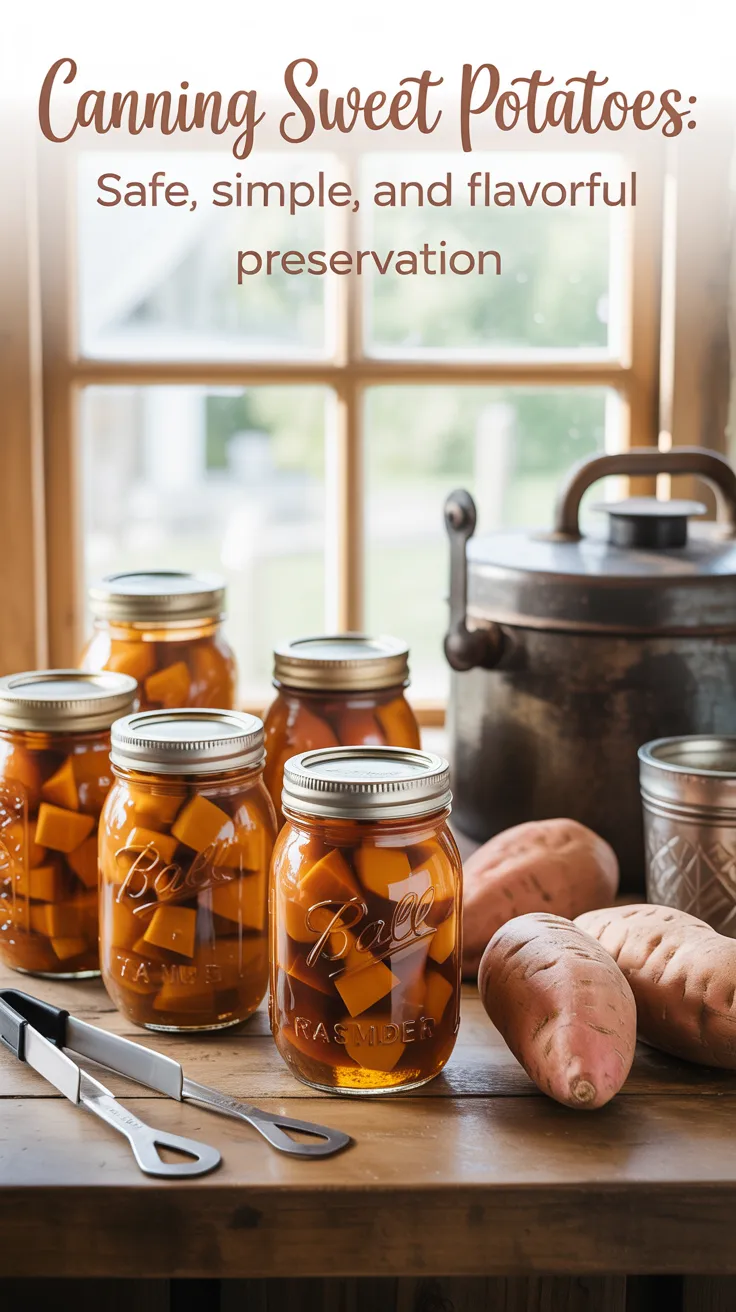
Canning sweet potatoes is one of the most rewarding ways to stock your pantry with nourishing, ready-to-eat comfort food. This guide walks you through the proven, safe pressure-canning method used by home preservers and extension services so you can confidently preserve your harvest and enjoy it for up to a year or more. From choosing the best tubers to processing times, altitude adjustments, and troubleshooting, you’ll find everything you need to do it right the first time.
If you love the self-reliant, long-shelf-life pantry that canning creates, you might also enjoy the preservation and preparedness ideas in The Lost SuperFoods for more ways to turn seasonal bounty into dependable meals.
Table of Contents
Safety Foundations for Canning Sweet Potatoes
Sweet potatoes are a low-acid vegetable. That single fact dictates the entire canning method: they must be pressure canned. Water-bath canning is not safe for low-acid foods—no amount of sugar or “longer boiling time” changes that, because Clostridium botulinum spores require the higher temperatures reached only under pressure to be neutralized. Pressure canning achieves temperatures above 240°F (116°C) and ensures heat penetrates to the core of each jar, especially important for dense foods like sweet potatoes.
Within the pressure-canning world, the standard, tested approach for sweet potatoes is hot pack. That means you pre-cook the potatoes before packing them in jars with boiling liquid. Hot packing removes excess air from the food, improves heat transfer, and reduces floating in the jar. Sweet potatoes should be packed in liquid—plain water or a light syrup—rather than dry-packed, again to aid safe and even heat penetration during processing.
Key safety points you’ll rely on:
- Use a true pressure canner, not an electric pressure cooker. Stove-top pressure canners with either a dial gauge or weighted gauge are standard.
- Pack sweet potatoes as uniform cubes or slices; avoid canning purées. Thick purées slow heat movement in jars and are not a tested safe canning method for sweet potatoes.
- Follow tested times and pressures based on altitude and canner type. For most elevations, pints are processed 65 minutes, quarts 90 minutes.
- Maintain proper headspace and remove air bubbles to ensure sealing and heat distribution.
- Never add thickeners, fats, or starches (like flour or cornstarch) into the canning liquid. Those alter heat movement in the jar.
Approach canning as a repeatable process: choose a tested method and follow it precisely. Once you understand the why (low-acid, dense texture, hot pack, pressure), the how becomes straightforward—and consistently safe.
Selecting and Preparing Sweet Potatoes for Canning
Quality in equals quality out. Start with small to medium sweet potatoes that are firm, smooth-skinned, and free from cuts, sprouts, or soft spots. Starchy, stringy, or over-mature roots can get mushy when cooked. Varieties like Beauregard, Jewel, and Garnet are commonly used; choose what’s abundant and best-looking in your market or garden.
Consider these prep steps for the best texture and color:
- Cure if homegrown. After harvesting, sweet potatoes improve in flavor and texture by curing 7–14 days in a warm, humid space (around 80–85°F / 27–29°C). Store after curing in a cool, dark place until canning day.
- Wash thoroughly. Dirt can harbor microbes. Scrub the skins under running water. Trim away any bad spots.
- Pre-cook to loosen skins. For hot pack, steam or boil whole sweet potatoes until skins slip easily and the centers are just tender—not fully soft. You want them firm enough to cut cleanly. Depending on size, this can be 15–25 minutes. Drain and let them cool slightly.
- Peel and cut uniformly. Slip off skins (a paring knife helps for stubborn areas). Cut into 1-inch cubes, thick slices, or large chunks. Uniform pieces ensure consistent heating in the jar.
- Optional anti-darkening. If desired, hold cut pieces in water with a little ascorbic acid to reduce browning while you prepare your jars. Rinse before proceeding to pack.
Choose your packing liquid:
- Plain water lets the natural sweetness shine and keeps options open for savory or sweet dishes later.
- A light syrup can preserve color and provide ready flavor. A typical light syrup is about 2 cups sugar to 1 quart of water; bring it to a full boil before ladling over packed jars. If you prefer just a hint of sweetness, reduce the sugar or use honey to taste.
- Savory ideas are best added after opening (e.g., butter, herbs). For canning, keep the liquid simple and clear.
Hot pack is the standard for sweet potatoes. After cutting, briefly simmer your chunks in boiling water or syrup for a couple of minutes to ensure everything is piping hot when it goes into jars. This will improve jar fill and reduce floating.
Tools, Jars, and Workspace Setup for Success
Having the right tools prepared and organized makes canning day smoother and safer. Here’s your basic setup:
- Pressure canner: Either dial-gauge or weighted-gauge. Ensure the gasket, vent, and safety plug are in good condition. If you use a dial gauge, have it tested annually for accuracy.
- Mason jars: Pint or quart jars are typical for sweet potatoes. Inspect for chips and cracks, especially on the rim. Wash in hot, soapy water, then keep them hot until filling (in the canner water at 180°F or in a 200°F oven, or by running a dishwasher heat cycle).
- Two-piece lids: Use new canning lids for each batch. Wash and prepare per the manufacturer’s instructions.
- Tools: Jar lifter, headspace gauge/bubble remover, wide-mouth funnel, ladle, clean towels, vinegar for wiping rims, and a trivet/rack for your canner.
- Boiling liquid station: A pot for your canning liquid (water or light syrup) kept at a rolling simmer so every ladle is truly hot.
- Prep station: Cutting board, knives, a large pot for pre-cooking sweet potatoes, and a colander for draining.
Good water is essential—both for washing produce and for filling jars. If your tap supply is limited or you’re building a preparedness pantry, having dependable stored water is a smart backup. A compact system like SmartWaterBox helps you set aside clean water for cooking, canning, and emergencies without taking over your space.
Before you start filling jars, set up a simple assembly line:
- Hot jars ready to go. 2) Hot sweet potato chunks in a pot. 3) Hot liquid simmering. 4) Tools and lids standing by. 5) Canner warming on the stove with a few inches of hot water and the rack in place.
A tidy workflow reduces the chance you’ll forget a step like de-bubbling or wiping rims. That’s more than convenience—consistency directly affects safe seals and proper processing.
Step-by-Step Method: Hot Pack Pressure Canning
This is the core process for canning sweet potatoes safely and reliably. Read through once before you begin, then follow step by step.
Preheat the canner. Add 2–3 inches of hot water to your pressure canner and place it on the stove over low-medium heat to keep the environment hot (not boiling hard yet).
Pre-cook the sweet potatoes. Steam or boil whole sweet potatoes until skins slip easily and the centers are just tender. Cool slightly, peel, and cut into 1-inch cubes or thick slices.
Heat the food and liquid. Return cut sweet potatoes to a pot and cover with boiling water or hot syrup; bring to a simmer for 2–3 minutes so everything is uniformly hot.
Fill hot jars. Using a slotted spoon and wide-mouth funnel, pack hot sweet potato pieces into hot jars. Ladle boiling liquid over them, leaving 1 inch of headspace. Do not pack the potatoes too tightly; gentle compression is okay but allow liquid to flow freely.
Remove air bubbles. Slide a bubble remover or a non-metal spatula down the inside of the jar in several places. Top up with more hot liquid to maintain 1-inch headspace.
Wipe rims and apply lids. Dip a clean cloth in vinegar and wipe jar rims to remove residue. Center new lids on jars and add bands, tightening to fingertip-tight (snug, not wrench-tight).
Load the canner. Place jars on the rack inside the canner. Secure the canner lid according to your model’s instructions, ensuring the vent pipe is open or the weight is off.
Vent steam for 10 minutes. Bring the canner to a vigorous vent—a strong column of steam from the vent pipe. Allow it to vent steadily for a full 10 minutes to purge air from the canner, which ensures accurate temperature.
Pressurize and process. Apply the weight or close the petcock and bring the canner to the target pressure for your elevation and gauge type (see next section). Start timing when the canner reaches and maintains the correct pressure. Process pints for 65 minutes and quarts for 90 minutes at the specified pressure.
Maintain pressure. Regulate your burner so pressure stays at or slightly above the target the entire time—never below. Fluctuations below the required pressure mean restarting the timing, which can overcook the food.
Cool the canner naturally. When the time is up, turn off the heat. Do not force-cool the canner. Allow pressure to return to zero naturally. Wait another 5–10 minutes, then remove the weight and open the lid away from you to avoid steam burns.
Remove and rest the jars. Lift jars straight up and place them on a towel, leaving space between them. Do not retighten bands or tip jars. Let them cool undisturbed for 12–24 hours.
Check seals and store. After cooling, verify seals (lids should be firm and slightly concave, no flex). Remove bands, wipe the jars clean, label with date, and store in a cool, dark place.
Follow this method and you’ll produce shelf-stable, beautiful jars with excellent texture and flavor, ready to become fast weeknight sides or holiday staples.
Times, Pressures, and Altitude Adjustments
Accurate processing time and pressure are what make canning sweet potatoes safe. Use the guidelines below and adjust for your altitude and canner type.
Jar sizes and times:
- Pints: 65 minutes
- Quarts: 90 minutes
Canner type and pressures:
- Weighted-gauge pressure canner:
- 0–1,000 ft: 10 pounds (10 lb)
- Above 1,000 ft: 15 pounds (15 lb)
- Dial-gauge pressure canner:
- 0–2,000 ft: 11 pounds (11 lb)
- 2,001–4,000 ft: 12 pounds (12 lb)
- 4,001–6,000 ft: 13 pounds (13 lb)
- 6,001–8,000 ft: 14 pounds (14 lb)
- Weighted-gauge pressure canner:
Key reminders for consistent results:
- Start timing only after the canner reaches the target pressure and stabilizes.
- If pressure dips below the target at any point, bring it back up and restart timing from the beginning for safety.
- Do not exceed headspace or pack jars too tightly; dense packs impede heat flow.
- Vent the canner for 10 minutes before pressurizing—this step is non-negotiable for safe, even heat.
If you’re new to pressure canning, practice with water-only loads first to get a feel for your stove and regulator behavior. A steady hand on the burner dial avoids pressure swings and helps you maintain safe processing without overcooking your jars.
Keep in mind that every canner has slight personality quirks. A dial-gauge unit requires you to monitor the needle; a weighted-gauge jiggles or rocks at a cadence that indicates correct pressure. Get familiar with the sounds and rhythm of your specific canner, and always double-check your altitude to ensure you’re processing at the correct pressure.
If you live above 8,000 feet, consult your local extension service for the latest guidance. Conditions at very high altitudes can require additional adjustments to ensure both safety and quality.
Flavor Options, Liquids, and Serving Ideas
The simplest and most versatile approach is to can sweet potatoes in plain water. You get clean, adaptable flavor for both sweet and savory dishes. Still, there are ways to infuse gentle taste and preserve color without compromising safety.
Safe liquid options:
- Plain water: Best for maximum flexibility and lowest added sugar.
- Light syrup: Dissolve about 2 cups sugar in 1 quart water, bring to a boil, and use to cover hot-packed sweet potatoes. Honey or maple can be used in place of some sugar for a subtle character.
- Spice-infused syrup: Simmer cinnamon sticks, a few whole cloves, or a strip of orange peel in your light syrup. Strain before ladling into jars to avoid whole spices in the jar (which can intensify over time).
Avoid adding fats or thickeners inside the jar. Butter, coconut oil, cream, or starches (flour, cornstarch) should be added only after you open the jar to cook and serve.
Serving ideas from a home pantry favorite:
- Everyday side: Drain and heat with a pat of butter and a pinch of salt. Add chopped parsley or rosemary for savoriness.
- Quick mash: Drain, warm, and mash with a splash of broth or milk, then season. Great with roasted chicken or pork.
- Sweet casserole base: Drain, add a little brown sugar or maple, cinnamon, and vanilla, then bake with pecans. Perfect for holidays.
- Savory hash: Dice and sear in a skillet with onions, peppers, and smoked paprika. Add sausage or beans for a protein boost.
- Pie shortcut: Drain thoroughly, then puree with your usual pie spices and eggs to make a fast sweet potato pie filling. Because you’re pureeing after opening, you’ll still reap the benefits of long-term storage with safe processing.
If you’re building a long-term pantry and want heritage food inspirations and shelf-stable meal concepts, resources like The Lost SuperFoods offer historically inspired preservation ideas you can adapt alongside your canning projects.
Cooling, Storage, and Troubleshooting Common Issues
Once the jars are out of the canner, how you handle them impacts seal quality and storage life.
Best practices for cooling and storage:
- Let jars rest undisturbed for 12–24 hours. Avoid drafts and don’t retighten bands.
- After cooling, check seals by pressing the center of each lid—no flex means sealed. Remove bands so they don’t rust onto the jars or mask a failed seal later.
- Wash jars and lids to remove residue. Label each jar with the contents and date.
- Store in a cool (50–70°F), dark, dry place. Avoid direct sunlight and temperature swings.
Shelf life and quality:
- Properly processed and sealed jars are typically best within 12–18 months for peak flavor and texture, though they may remain safe longer. Rotate stock—first in, first out.
- Before using, always inspect: lid still concave and tight, liquid clear, no off odors, and no spurting liquid when opened. When in doubt, throw it out.
Troubleshooting tips:
- Floating sweet potatoes: Common, especially with lighter packing or syrup. Hot packing and removing bubbles help. Gentle packing density also reduces floating.
- Siphoning (liquid loss from jars): Often caused by rapid pressure changes or removing jars too soon. Allow the canner to depressurize fully and rest before opening. Some liquid loss is okay if jars are sealed and food remains covered mostly by liquid.
- Cloudy liquid: Starch from the potatoes or minerals in hard water can cloud the liquid. It’s usually a quality issue, not a safety issue, provided you followed correct processing.
- Soft or mushy texture: Overcooking during pre-cook or pressure swings can do this. Next time, reduce pre-cook time so pieces stay quite firm before hot pack.
- Darkening: Natural pigments can shift during canning. Using fresh sweet potatoes, avoiding overcooking, and packing hot with adequate liquid helps preserve color.
Kitchen safety and preparedness go hand in hand. Canning days can be busy, and minor kitchen mishaps happen. Keeping a practical home medical reference like Home Doctor on your shelf can give you peace of mind for everyday scrapes, burns, and common ailments while you focus on preserving your harvest.
Cost, Yield Planning, and Pantry Integration
Canning sweet potatoes is not just about preservation—it’s about planning meals and managing resources. Consider these points for efficient batch days:
- Yield expectations: A heaping pound of prepared, peeled sweet potato pieces roughly fills a pint jar; about two heaping pounds per quart. For a canner load, plan your raw weight accordingly plus a cushion for trimming and peeling.
- Batch size: Balance the size of your canner and your prep capacity. A 7-quart batch is typical for standard canners; second batches go faster since your workflow is established.
- Liquid volume: For 7 quarts, prepare approximately 10–12 cups of hot liquid (water or syrup) to ensure you have enough to top off jars after de-bubbling.
- Meal planning: Think in meal units. If your household often serves sweet potatoes as a side for four, pints may be perfect. For casseroles and pies, quarts can be more efficient.
- Rotation: Label jars with “month/year” and place newest stock at the back of the shelf to encourage first-in, first-out usage.
From a self-reliance standpoint, sweet potatoes offer dense nutrition—carbohydrates, fiber, beta-carotene—and pair well with shelf-stable proteins and greens. Keeping a steady stream of canned basics simplifies weeknights and builds resilience against supply disruptions.
If water reliability is a concern in your area—or you simply want a planned backup for canning days—consider a compact storage solution like SmartWaterBox so your kitchen projects don’t stall when the tap won’t cooperate.
Step-By-Step Recap for Quick Reference
For fast review on canning day, here’s a concise recap:
- Select firm, sound sweet potatoes. Wash thoroughly.
- Pre-cook whole until skins slip and centers are just tender. Peel and cut into 1-inch pieces.
- Hot pack: Simmer cut pieces briefly in boiling water or light syrup.
- Pack hot jars with sweet potatoes; cover with boiling liquid, maintaining 1-inch headspace.
- De-bubble, adjust headspace, wipe rims with vinegar, apply lids and bands fingertip-tight.
- Load jars into a prepared pressure canner. Vent steam 10 minutes.
- Process pints 65 minutes, quarts 90 minutes at your altitude-adjusted pressure:
- Weighted gauge: 10 lb (0–1,000 ft); 15 lb (>1,000 ft)
- Dial gauge: 11 lb (0–2,000 ft), 12 lb (2,001–4,000 ft), 13 lb (4,001–6,000 ft), 14 lb (6,001–8,000 ft)
- Let pressure return to zero naturally. Rest 5–10 minutes, open lid away from you.
- Cool jars 12–24 hours. Check seals, remove bands, label, and store cool and dark.
Conclusion
Canning sweet potatoes turns a seasonal staple into year-round convenience—safe, flavorful, and ready for everything from quick weeknight sides to holiday showstoppers. By pressure canning with a tested hot-pack method, respecting times and altitude adjustments, and keeping your workflow organized, you’ll produce jars you’re proud to stack on the shelf. As you build out a resilient pantry, consider adding preservation know-how from The Lost SuperFoods and practical household readiness with resources like Home Doctor and a reserve water setup via SmartWaterBox. With a few focused afternoons, your pantry can be both delicious and dependable.
FAQ
Can I water-bath can sweet potatoes?
No. Canning sweet potatoes requires a pressure canner because they’re a low-acid vegetable. Only pressure canning reaches the temperatures necessary to make low-acid foods safe for shelf storage.Can I can mashed sweet potatoes?
For safety, can sweet potatoes as cubes or slices in liquid. Purees and butters are too dense for reliable heat penetration in jars and aren’t recommended for home canning. Mash after opening the jar.How long do home-canned sweet potatoes last?
For best quality, use within 12–18 months. Always inspect jars before use—check that the seal is intact, liquid is clear, and there are no off odors. When in doubt, discard.Do I need to add sugar when canning sweet potatoes?
Sugar is optional. You can can in plain water or a light syrup. Sugar can help with color and flavor but isn’t required for safety. Keep the liquid clear and free of fats or thickeners.What pressure and time should I use for canning sweet potatoes?
Process hot-packed sweet potatoes at 65 minutes for pints and 90 minutes for quarts. Use 10 lb on a weighted-gauge canner up to 1,000 ft (15 lb above 1,000 ft). For dial-gauge canners, use 11 lb up to 2,000 ft, then increase 1 lb for each additional 2,000 ft (12 lb at 2,001–4,000 ft; 13 lb at 4,001–6,000 ft; 14 lb at 6,001–8,000 ft).