
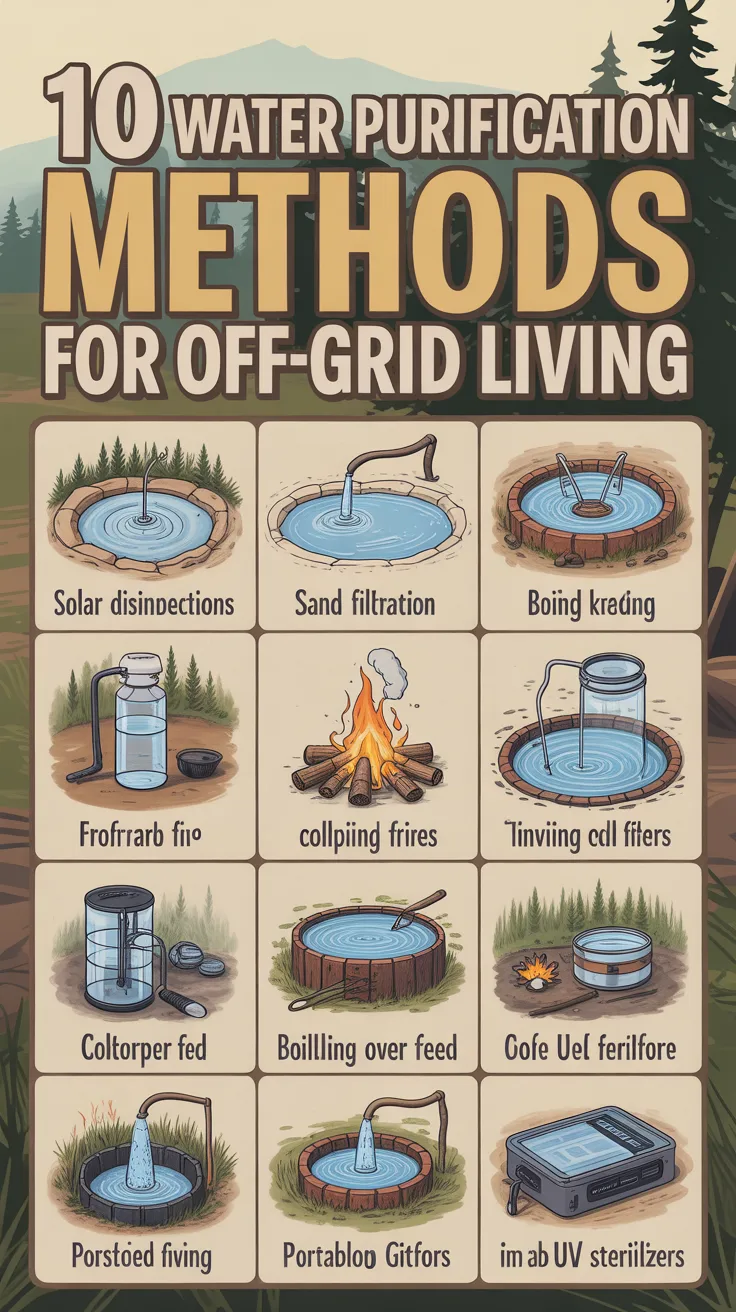
Clean, safe water is the backbone of any self-reliant lifestyle. Whether you’re homesteading, van dwelling, or preparing for grid-down scenarios, mastering 10 water purification methods for off-grid living gives you redundancy, flexibility, and peace of mind. This guide explains how to combine simple, low-power, and rugged techniques into a reliable multi-barrier system that handles a wide range of contaminants and real-life constraints like fuel, sun, filter life, and storage.
If you plan to build a dependable off-grid setup, a gravity-based purifier can be a strong low-tech anchor. Explore options like the Aqua Tower as part of your core system.
Table of Contents
Foundations of off-grid water safety
Before diving into individual technologies, it’s essential to understand how water gets contaminated and why a multi-barrier approach works best. Off-grid sources—rivers, ponds, shallow wells, rooftops, snowmelt—can carry a mix of hazards:
- Biological: bacteria (E. coli), viruses (norovirus), protozoa (Giardia, Cryptosporidium), helminths.
- Chemical: nitrates, heavy metals (lead, arsenic), pesticides, hydrocarbons.
- Physical: silt, rust, organic debris that make water turbid and shield microbes.
No single method addresses everything efficiently. That’s why experienced off-gridders layer processes in a sequence—clarify and filter first, then disinfect, then polish taste and odor, and finally store safely. Think of it like a chain: the fewer weak links, the stronger your system.
Key principles to internalize:
- Source selection: upstream and spring sources are typically safer than stagnant water. Clear water is easier and faster to treat than cloudy water.
- Pretreatment matters: settling, straining, and prefilters dramatically improve performance of fine filters and disinfection.
- Contact time is critical: chemical and UV disinfection require sufficient time and clarity to work effectively.
- Maintenance is non-negotiable: every filter and vessel needs cleaning schedules and part replacements. Keep spare elements, O-rings, and a written log.
- Test periodically: affordable field tests for bacteria indicators, pH, TDS, and selective heavy metals help you validate assumptions and tune your setup.
The 10 methods below can be mixed and matched to fit your water sources, climate, and energy budget.
Core methods in 10 Water Purification Methods for Off-Grid Living
This section introduces the first two pillars of low-tech water safety that nearly everyone can implement anywhere: boiling and solar pasteurization. Both are powerful because they have minimal equipment requirements and predictable results when applied correctly.
1) Boiling
Boiling is the most universal and reliable way to kill biological hazards. At a rolling boil, water reaches temperatures that inactivate bacteria, viruses, and protozoa. Because boiling does not remove chemicals or sediment, it’s best used after basic clarification.
How to do it effectively:
- Pre-filter cloudy water using a clean cloth or coffee filter to speed heating and improve taste.
- Bring water to a rolling boil for at least 1 minute. At elevations above 2,000 meters (6,500 feet), boil for 3 minutes due to lower boiling temperatures.
- Let it cool with a lid on to protect from recontamination and reduce evaporative losses.
Pros:
- Very high biological kill rate.
- No consumable filter parts.
- Works with wood, gas, alcohol, solar cookers.
Cons:
- Energy-intensive; not ideal for large volumes.
- Concentrates some volatile chemicals and doesn’t remove heavy metals.
- Hot water handling and storage require care to stay sanitary.
Use cases:
- Emergencies, winter conditions, or when your filter capacity is maxed out. Excellent backup for any off-grid kit.
2) Solar water pasteurization
You don’t need a rolling boil to make water safe. Pasteurization inactivates pathogens at lower temperatures (typically 65–75°C / 149–167°F) if held long enough. A simple solar cooker or a dark bottle in a reflective enclosure can pasteurize water on sunny days with no fuel.
Tips for success:
- Use a Water Pasteurization Indicator (WAPI) or a simple candy thermometer to confirm temperatures reached.
- Keep volumes manageable (1–2 liters per session) and use dark glass or blackened metal containers to absorb heat.
- Avoid very turbid water; pre-filter for better performance.
Pros:
- Zero fuel cost in sunny climates.
- Gentler on containers and less mineral scaling than boiling.
Cons:
- Weather-dependent; slow in winter or cloudy conditions.
- Does not remove chemicals or sediment; requires pre-filtering.
Pasteurization complements boiling as a fuel-saving daytime method during long-term off-grid living.
Gravity and ceramic filtration
Filtration physically removes particles and many microbes by passing water through porous media. Gravity and ceramic systems are workhorses for cabins and homesteads because they require no power, produce steady daily volumes, and are easy to maintain.
3) Gravity-fed filters (hollow fiber, carbon blocks)
Gravity systems use upper and lower tanks—dirty water flows down through filter elements into a clean chamber. Common elements include hollow fiber membranes (with pore sizes around 0.1–0.2 microns) and carbon blocks.
Strengths:
- Excellent for removing sediment and bacteria, and often protozoa.
- Carbon significantly improves taste and removes many organic compounds and some chlorine byproducts.
- Scales well: larger tanks process multiple gallons per day.
Limitations:
- Most gravity filters do not remove viruses without additional disinfection.
- Carbon has finite capacity for chemicals; follow replacement intervals.
- Flow rate can drop with turbidity; pre-settling helps.
Care and maintenance:
- Backflush hollow fiber elements as instructed to restore flow.
- Replace carbon elements on schedule; record start dates.
- Protect the clean tank from hands, dippers, and contaminated lids.
4) Ceramic candles and bio-sand filters
Ceramic elements—often diatomaceous earth with silver impregnation—are classic off-grid options. They’re cleanable, durable, and effective at removing bacteria and protozoa. Bio-sand filters, built from layers of sand and gravel with a biologically active layer (schmutzdecke), offer household-scale throughput with minimal ongoing costs.
Ceramic candles:
- Can be scrubbed gently to restore flow when clogged.
- Typically pair with carbon for taste and chemical reduction.
- Do not reliably remove viruses; add a disinfection step.
Bio-sand filters:
- Require correct construction and a maturation period for the biological layer to develop.
- Effective against turbidity, bacteria, and protozoa; not designed for chemicals.
- Low maintenance once established—ideal for steady home use.
Mid-article resource: To explore compact, modular solutions you can integrate alongside gravity systems, consider the New Water Offer: SmartWaterBox as part of a layered strategy.
Chemical and UV disinfection
Filtration alone rarely guarantees virus inactivation. Chemical and UV disinfection bridge that gap. Used after filtration, they deliver a powerful one-two punch.
5) Chlorine disinfection (household bleach or calcium hypochlorite)
Unscented, plain household bleach (sodium hypochlorite) is widely recommended for emergency water disinfection.
General guidelines:
- For clear water using 6% unscented bleach: add 8 drops per gallon (about 2 drops per liter). For 8.25% bleach: add 6 drops per gallon (about 1–2 drops per liter). Stir, wait 30 minutes. You should detect a slight chlorine odor; if not, repeat and wait another 15 minutes.
- For turbid water, filter/settle first. If necessary, you may double the dose, but always aim to clarify ahead of time for best results.
- Store bleach away from heat and sunlight; potency declines over time.
An alternative is calcium hypochlorite (pool shock) to make a chlorine solution. Handle carefully, follow label instructions, and never mix with other chemicals.
Strengths:
- Inactivates bacteria and viruses effectively.
- Leaves a protective residual in storage containers.
Limitations:
- Less effective against some protozoan cysts (e.g., Cryptosporidium).
- Can impact taste and odor; carbon post-treatment helps.
6) Iodine tablets and tincture
Iodine products are compact, light, and common in backpacking kits. They’re suitable for short-term use when taste and long-term health considerations (thyroid, pregnancy) are not a concern.
Usage tips:
- Follow product-specific dosing and wait times; colder water needs longer contact time.
- Use a neutralizer (often included) after disinfection to reduce iodine taste.
- Avoid prolonged reliance and note health contraindications.
Best use:
- Fast, portable disinfection for clear mountain water paired with a prefilter.
7) UV light and solar disinfection (SODIS)
UV pens and UV pump systems expose water to germicidal wavelengths, inactivating bacteria, viruses, and protozoa if water is clear. Solar disinfection (SODIS) uses sunlight to inactivate pathogens inside clear PET bottles laid in full sun for 6+ hours (longer in cloudy weather).
Best practices:
- Pre-filter until water is visibly clear; UV works poorly in turbid water.
- Follow volume and time limits per device; mix to expose all layers.
- For SODIS, use intact PET bottles, remove labels, and place on reflective surfaces.
Pros:
- No chemical taste.
- Lightweight for travel; scalable with multiple bottles for SODIS.
Cons:
- No residual disinfectant; risk of recontamination if storage lapses.
- Weather and battery dependent.
Adsorption and media-based polishing
This category targets taste, odor, and specific contaminants through adsorption and ion exchange. While these methods are not primary disinfection, they’re vital for making water pleasant and tackling certain chemicals.
8) Activated carbon, bone char, and specialty media
Activated carbon (granular or block) binds many organic compounds, chlorine, and some disinfection byproducts, improving taste and smell. Bone char can reduce fluoride and some heavy metals. Specialty resins (ion exchange) and zeolites can target nitrates, ammonia, and certain metals.
How to apply:
- Use carbon after disinfection to polish flavor and remove residual chlorine.
- For targeted contaminants, select media rated for that contaminant and observe flow rates and contact times.
- Replace on schedule or when taste returns; exhausted carbon can release trapped compounds.
Strengths:
- Noticeably better taste encourages proper hydration and use.
- Useful for rainwater systems to remove rooftop organics.
Limitations:
- Media are consumables; keep spares.
- Performance depends on contact time and water chemistry; lab confirmation is ideal when contaminants are suspected.
Sourcing media modules:
- Many gravity and inline systems accept standardized cartridges, making swaps easy.
- When in doubt, run small pilot batches and test for the target contaminant.
If you’re researching a broader blueprint for water independence, a planning resource like Joseph’s Well can complement hands-on gear by helping you think through sourcing, redundancy, and maintenance.
Distillation and reverse osmosis off-grid
Distillation and reverse osmosis (RO) are heavyweight methods that tackle dissolved salts and many chemicals beyond the reach of most simple filters. They demand more energy or pressure but can be game-changers for specific scenarios.
9) Distillation (including solar stills)
Distillation boils water and condenses the steam, leaving most contaminants behind. It’s particularly valuable for brackish water, seawater, and removing many heavy metals and nitrates.
Options:
- Stove-top or wood-fired stills: produce consistent results with heat sources you control. Build using stainless pots, copper coil, and a condenser jar.
- Solar stills: low-output but completely off-grid. Box-style solar stills outperform pit stills. Expect modest daily yields; scale with multiple units.
Strengths:
- Excellent for desalination and many chemicals.
- Reliable microbiological safety when condensate is protected.
Limitations:
- Energy-intensive; output per fuel unit may be lower than other methods.
- Volatile organic compounds (VOCs) with lower boiling points than water may carry over; include a pre-carbon stage or condense discards initially.
Use cases:
- Coastal homesteads, drought resilience, and emergency fallback when surface sources are compromised.
10) Reverse osmosis (RO) with off-grid power
RO forces water through a semi-permeable membrane, rejecting salts, many organics, and pathogens. It’s highly effective but requires pressure (50–80+ psi) and produces a brine wastewater stream.
Off-grid considerations:
- Power source: pair RO with solar + battery and a pressure pump, or use manual pumps sized for the membrane.
- Pretreatment: sediment and carbon prefilters prolong membrane life; foul membranes are costly to replace.
- Waste ratio: plan for concentrate disposal or reuse (e.g., cleaning) and ensure feedwater volume supports RO.
Strengths:
- Broad-spectrum contaminant reduction, including salinity.
- Excellent polishing for problematic sources.
Limitations:
- System complexity and maintenance.
- Mineral-stripped taste; remineralization or blending may improve flavor.
To round out your modular stack, evaluate portable or modular components such as the New Water Offer: SmartWaterBox alongside your base filtration and disinfection methods.
A practical multi-barrier plan using 10 Water Purification Methods for Off-Grid Living
Methods are tools; plans are systems. Here’s how to combine the 10 water purification methods into daily, weekly, and emergency workflows that scale from a solo off-grid cabin to a family homestead.
Daily workflow (clear surface water or rainwater):
- Settle and strain: let buckets sit for 2–4 hours; pour off the clearer top. Use a fabric prefilter if needed.
- Gravity filter: run through ceramic/hollow fiber + carbon for taste.
- Disinfect: dose with chlorine or run through UV, depending on your setup. If you chlorinate first for storage, run through carbon afterward to improve taste.
- Store: use food-grade containers with narrow necks and spigots. Label date and treatment method.
- Consume within 1–2 weeks; check residual chlorine weekly if using chemical disinfection.
Daily workflow (shallow well or uncertain sources):
- Pre-filter and gravity filter as above.
- Combine disinfection: UV or chlorine as standard; boil when in doubt or during illness outbreaks.
- Weekly test with field strips for nitrate and a basic bacteria indicator. If contaminants persist, consider RO or distillation for drinking water while using filtered water for cooking and washing.
Emergency workflow (turbid floodwater, algae blooms):
- Coagulate and settle if possible: a pinch of alum or natural coagulants (like crushed seeds) can speed clarification; let settle, then decant carefully.
- Run through ceramic/bio-sand to remove sediment and protozoa.
- Disinfect aggressively: chlorine at appropriate doses with extended contact time, or boil for 3 minutes at altitude.
- Polish with carbon to improve palatability.
Maintenance rhythm:
- Backflush/clean filters on a set day each week.
- Rotate chemical stocks (bleach degrades within months; calcium hypochlorite stores longer when kept dry).
- Inspect seals and hoses each month to prevent cross-contamination between dirty and clean sides.
- Record flows: sudden drops often signal clogging or biofilm.
Power planning:
- Size solar/battery to handle UV or RO if those are central; keep manual backups (boiling, pasteurization, gravity filters).
- Standardize on cartridge sizes to streamline spares.
Call to action: If you’re assembling a core system for a cabin or homestead, a gravity purifier is a dependable hub you can build around. Explore the Aqua Tower for baseline daily production, then layer UV or chlorine and carbon polishing for a robust multi-barrier setup.
Choosing the best options among 10 Water Purification Methods for Off-Grid Living
No two off-grid scenarios are the same. Your climate, source water, energy profile, and storage needs dictate the optimal mix. Use these decision factors to tailor your stack:
Source profile:
- Rainwater: typically low in minerals, may contain rooftop organics and bird droppings. Gravity + carbon + UV/chlorine is efficient.
- Clear streams/springs: gravity + UV or chlorine is efficient; keep boil as backup.
- Turbid rivers/ponds: bio-sand or ceramic first, then disinfection; consider carbon for taste.
- Brackish/coastal: distillation or RO for drinking; use filtered raw water for non-potable needs.
Energy budget:
- Low/no power: boiling/pasteurization, gravity, ceramic, SODIS.
- Modest solar: UV systems, small pumps, LED UV reactors.
- Higher power: RO systems with pumps.
Health considerations:
- Immunocompromised households benefit from combining filtration with robust disinfection and careful storage.
- Taste-sensitive users appreciate carbon polishing and remineralization.
Redundancy:
- Keep at least three independent paths to safe water: e.g., gravity + chlorine + boiling as fallbacks.
- Store a week of treated water per person; more in hot climates.
Mid-content note: For guides and modular kits that slot into layered systems, evaluate the New Water Offer: SmartWaterBox. For broader resilience planning around wells and sourcing, see Joseph’s Well.
Recommended off-grid water resources
These picks are meant to complement the methods above by helping you assemble, scale, or diversify your system. Incorporate them where they fit your goals and budget.
- Aqua Tower: A gravity-based cornerstone you can run daily and pair with chemical or UV disinfection for added protection. Aqua Tower
- New Water Offer: SmartWaterBox: A compact, modular water solution to integrate with filtration/disinfection workflows or use as a portable backup. SmartWaterBox
- Joseph’s Well: A planning-oriented resource for improving water independence from sourcing to storage and maintenance. Joseph’s Well
Use these alongside DIY builds like bio-sand filters and stills to maximize redundancy.
Conclusion
Mastering 10 water purification methods for off-grid living empowers you to handle shifting water quality, weather, and power limitations without stress. Start with a strong daily driver—gravity or ceramic filtration—then add disinfection (chlorine or UV), a taste-polishing stage (carbon), and strategic heavy hitters (distillation or RO) for niche needs like brackish sources. The result is a resilient, multi-barrier system that keeps your household hydrated safely year-round. Review your plan seasonally, log maintenance, and keep backups for each critical function. The more layers you build, the more freedom you gain.
Frequently asked questions
What’s the simplest off-grid setup that still keeps water safe?
- A clear-water workflow that many off-gridders use is: settle → gravity filter (ceramic/hollow fiber + carbon) → chlorine dose with 30-minute contact time → store in sealed containers. Boil during illness outbreaks or if water turns cloudy.
How do I choose between UV and chlorine for disinfection?
- UV avoids chemical taste and works fast but requires clear water and power, with no residual protection. Chlorine is low-tech, leaves a protective residual, and is easy to scale, but has taste and is less effective against some protozoa. Many households use both depending on context.
Which of the 10 water purification methods for off-grid living can handle seawater?
- Distillation and reverse osmosis are the practical choices for desalination. Gravity and ceramic filters cannot remove dissolved salt. For coastal homesteads, consider RO for daily use with solar power, and a wood-fired still as a backup.
How can I improve the taste of chlorinated water?
- Run the treated water through an activated carbon stage after the contact time, or aerate by pouring back and forth between clean containers. Chilling also helps. If using as a primary approach, schedule carbon replacements to keep flavor high.
Do I need to test my water if I’m already filtering and disinfecting?
- Yes. Periodic testing validates your assumptions and helps detect changes in source quality. Use indicator tests for bacteria, strips for nitrates and pH, and targeted tests for specific risks like arsenic. Testing guides maintenance and method selection.