
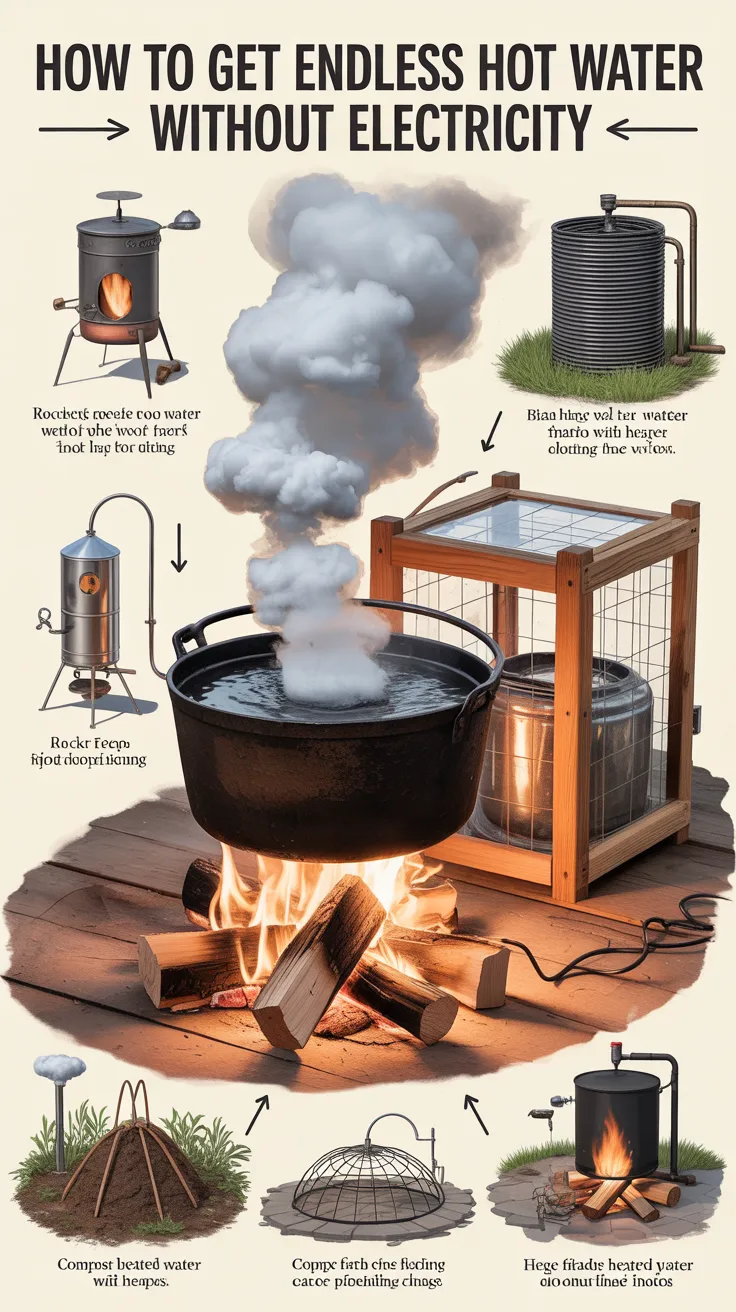
When the grid goes down—or you simply want to slash utility bills—reliable hot water doesn’t have to disappear. With the right mix of passive solar, wood-fired, or fuel-based systems, you can learn how to get endless hot water without electricity safely and affordably. This guide walks you through practical, code-aware options you can build or buy, from simple solar batch heaters to thermosiphon setups and ultra-reliable propane systems that don’t need power-hungry pumps or controls.
If you’re planning a resilient, off-grid water setup, a comprehensive resource like SmartWaterBox can help you blueprint storage, pressure, filtration, and redundancy from day one.
Table of Contents
Determine your real-world demand and set safety as the non-negotiable
Before you touch a wrench or buy a tank, define your hot water goals. Endless hot water without electricity is achievable, but only if your supply, storage, and heat source match your real household profile.
- Usage profile: Count fixtures and flows. A low-flow shower head is ~1.5–2.0 gpm. Handwashing is ~0.5 gpm. Dishwashing by hand runs ~1–2 gpm. Estimate your “peak draw”—what runs at the same time—and your daily gallons (typical conservative households use 10–20 gallons of hot water per person per day).
- Temperature targets: Domestic hot water is typically stored at 120–140°F (49–60°C). The colder your source water and the cooler your climate, the more collector area or fuel you’ll need to reach and maintain setpoint.
- “Endless” vs. “adequate”: Storage size and recovery rate dictate the “endless” feel. Larger, better-insulated storage plus a steady heat input (sun, wood, or gas) will let you run longer showers and multiple tasks without running cold.
Safety and compliance come first:
- Use a T&P (temperature and pressure) relief valve on every storage tank. This is non-negotiable to prevent dangerous overpressure or steam events.
- Include a thermostatic mixing (tempering) valve at the outlet. Solar and wood-fired heaters can exceed 160°F on good days; anti-scald protection blends to safe delivery temperatures.
- Choose potable-rated components: copper, stainless, PEX-AL-PEX, and certified fittings in the domestic side. Avoid using automotive parts or un-rated hoses anywhere the water will be consumed or used for bathing.
- Legionella mitigation: Store hot water at 140°F with a mixing valve on outlets to deliver
120°F. Avoid lukewarm long-term storage (95–115°F) that can encourage bacterial growth. - Pressure and head: A gravity-fed tank 20–30 feet above fixtures can deliver usable pressure without pumps. In pressurized systems, ensure your pressure-reducing valve and expansion tank are properly sized.
- Combustion safety: For wood or propane systems, vent correctly, follow clearance-to-combustibles, and install CO and smoke detectors. Respect local code.
With clear targets and safety measures in place, you can choose the best off-grid pathway for your site and budget.
Passive solar batch heaters deliver big gains with small budgets
One of the simplest, most cost-effective methods is a batch (integral collector–storage, or ICS) solar heater. It uses the sun to warm a dark tank inside a glazed box—no pumps, no electronics, no moving parts.
How it works:
- A dark, insulated tank sits in a box with a transparent front (glass or polycarbonate). Sunlight heats the tank directly.
- Cold water flows in at the bottom; hot water leaves at the top, either directly to fixtures or to a primary storage tank.
- Gravity or municipal pressure moves water—no electricity required.
Build and placement principles:
- Orientation and tilt: Face the collector true south (in the Northern Hemisphere) with a tilt near your latitude for year-round performance. Roof or ground racks both work if the collector has full sun from 9 a.m. to 3 p.m.
- Absorption and insulation: Paint or select a black tank and insulate the enclosure (sides/back) with rigid foam. Seal air gaps to reduce convective losses.
- Glazing: Use tempered glass or UV-stable polycarbonate. Double glazing reduces heat loss in shoulder seasons.
- Plumbing: Keep runs short and insulated. Use a mixing valve downstream because batch heaters can get very hot on clear days.
- Freeze protection: In freezing climates, choose a drainable seasonal design, add a bypass for winter, or use an all-weather thermosiphon system (next section). Always plan for freeze-thaw expansion.
Right-sizing tips:
- For two people in a sunny climate, a 30–40 gallon ICS heater can cover a high share of daily needs. For larger families, multiple tanks or a hybrid system (solar preheats, wood or propane tops up) keeps the “endless” feeling even on cloudy stretches.
- Add storage: Even a modest 30–50 gallon insulated storage tank downstream of the collector increases capacity and smooths temperature swings.
Advantages:
- Lowest complexity and cost
- Truly off-grid, passive, and durable
- Tangible reductions in fuel use even if paired with a backup
Limitations:
- Performance varies with weather and season
- Freeze risk unless drained or winterized
- Heavier units may prefer ground mounts over roofs
With smart placement and a mixing valve, a batch heater is an excellent first step toward truly endless hot water without electricity.
Thermosiphon solar systems provide daily “auto-circulation” with no pump
Thermosiphon systems use a fundamental principle: hot water rises, cold water sinks. That buoyancy drives circulation between a solar collector and a storage tank—no pumps, no power.
Core layout:
- The storage tank sits above the collector—sometimes on the roof or a high platform.
- The hot outlet at the top of the collector rises to the top of the tank; the cool return from the bottom of the tank drops to the collector inlet.
- Larger-diameter piping (often 3/4″ or 1″) minimizes friction so gravity can do the work. Keep runs short and mostly vertical for strong thermosiphon action.
- A check valve (gravity or swing type) prevents reverse flow at night.
Collector choices:
- Flat-plate collectors: Affordable and robust; work well in temperate climates. Insulated boxes with copper risers and a dark absorber plate under glazing.
- Evacuated tubes: Higher efficiency in cold, windy, or diffuse-light conditions. Thermosiphon-ready manifolds exist where heat pipes deliver heat to a header feeding the tank above. They can reach higher temperatures and extend the solar season.
Open-loop vs. closed-loop:
- Open-loop (direct): Potable water runs through the collector into the tank. Simple and efficient, but susceptible to scaling and freeze damage. Better for non-freezing climates.
- Closed-loop (indirect): Antifreeze (glycol) circulates through the collector, transferring heat via a heat exchanger inside or attached to the storage tank. This is the safer choice for freezing climates and extends year-round usability.
Protection and control:
- Overheat management: Include a pressure relief valve on the solar loop (closed systems) and a T&P on storage. Shade cloth or summer bypass can help if you experience frequent summer stagnation.
- Freeze mitigation: Closed-loop glycol systems are the gold standard in cold climates. For mild climates, drainback-style systems exist, but they typically need a pump; so for a zero-electric approach, stick with true thermosiphon and indirect glycol.
- Mixing: As always, finish with a thermostatic mixing valve for scald protection.
A well-built thermosiphon system paired with an adequately sized, well-insulated tank can deliver morning-to-night hot water across much of the year, truly without electricity. To round out your off-grid water independence with storage and distribution planning, see SmartWaterBox for resilient, non-electric water system strategies you can adapt to any homestead.
Wood-fired and biomass heaters offer on-demand heat in any weather
When the sun isn’t shining—or you want a system that works in storms and at night—wood-fired options provide reliable, fuel-flexible hot water without electricity. Three proven approaches:
- Coil-on-stove thermosiphon
- A stainless or copper coil sits on, behind, or inside a woodstove or cookstove.
- The coil connects to a nearby storage tank: bottom of the tank to coil inlet (cold), coil outlet back to the top of the tank (hot). As the coil heats, water rises into the tank, pulling cooler water into the coil.
- Use a T&P valve on the tank, a vacuum break/vent as required by code, and route pressure relief lines safely.
- Keep runs short and pitched upward from coil to tank to sustain natural circulation.
- Rocket stove or simple wood-fired water heater
- A rocket stove (high-efficiency combustion) can heat a coil or a water jacket. These excel in fuel efficiency with twigs and small-diameter wood.
- Thermosiphon into an open-vented or safely controlled tank. Include firebox temperature management to avoid flash boiling.
- Great for batch jobs like bath nights, dishwashing, or laundry.
- Range boiler setups with old-style wood cookstoves
- Many classic cookstoves were designed with water coils (water fronts) for heating a nearby range boiler tank.
- The same principles apply: thermosiphon, relief valves, mixing valves, and potable-rated materials.
Critical safety notes:
- Never trap a coil full of water between two valves on a heat source. If it can’t expand, it can explode. Use open-vented or properly relieved systems only.
- Always include a clear thermal path for rising hot water and install a T&P valve on any closed vessel connected to heat.
- Place the storage tank at or above the coil height when relying on thermosiphon. Avoid long horizontal pipe runs that stall flow.
Practical usage:
- Pair a wood-fired heater with solar preheat for a “best of both worlds” system: the sun covers most days, wood tops up on cloudy streaks.
- With a large, well-insulated tank, you can heat once and enjoy hours of hot water across the day, still without electricity.
Fuel-based, non-electric propane systems can be ultra-reliable
If you want near-instant, controllable, and “always on” hot water without electricity, propane-powered heaters designed for off-grid use are hard to beat. Two main options:
Standing-pilot tank water heaters:
- Many conventional tank heaters use a standing pilot and mechanical gas valve, requiring no electricity. They deliver stored hot water 24/7 and slowly reheat as needed.
- Advantages: Simplicity, compatibility with hard water, and easier venting (atmospheric draft models).
- Considerations: Requires safe venting, combustion air, and periodic maintenance (sediment flushing, anode checks). Fuel usage is constant if the tank is kept hot, so insulate hot lines well and consider a lower setpoint with a mixing valve.
Battery-ignition or hydrogenerator tankless heaters:
- Some tankless units ignite using small batteries or an internal hydrogenerator, avoiding the need for grid power. These give “endless” hot water as long as you have fuel and sufficient water pressure.
- Advantages: Compact, efficient, continuous hot water at set flow rates.
- Considerations: Proper venting (especially for high-efficiency condensing models), minimum flow rates, altitude derating, and winter freeze protection if installed in unconditioned spaces. Confirm your model truly operates without external electricity.
Best practices:
- Venting: Use manufacturer-specified venting and clearances. CO safety is paramount.
- Fuel storage: Protect tanks from extreme heat and physical damage; use up-to-date regulators and test connections for leaks with soapy water, never flame.
- Tempering: Tankless outlets can be hot and variable; a mixing valve downstream stabilizes delivery temperature.
Hybrid strategy:
- Use solar to preheat incoming water to reduce fuel consumption. For example, feed a propane tankless with 80–100°F water from a solar tank. The heater then lifts it to your setpoint using much less fuel, maintaining the “endless” feel without electricity.
Storage, distribution, and controls that work without a single wire
Even the best heater underperforms with poor storage and distribution. Optimize the rest of the system so hot water arrives fast, safely, and efficiently—no pumps or controllers required.
Storage that stretches supply:
- Bigger is smoother: A 60–120 gallon well-insulated tank evens out clouds and peak usage, making “endless” feel realistic at the taps.
- Stratification matters: Plumb inlets low and outlets high on the tank to maintain thermal layers. Avoid mixing the whole tank when drawing small amounts.
Gravity-fed distribution:
- Elevation equals pressure: A storage tank 30 feet above fixtures yields roughly 13 psi. For low-rise homes and cabins, attic or tower tanks can provide comfortable flow without pumps.
- Short, insulated runs: Cluster bathrooms and kitchen near the tank. Use 1/2″ lines to fixtures to reduce wait times. Insulate hot lines end-to-end to maintain temperature.
Non-electric control strategies:
- Thermostatic mixing valves: Set them to ~120°F at the delivery side. They provide scald protection even when storage exceeds 140°F.
- Mechanical tempering at fixtures: Anti-scald shower valves add a second layer of safety.
- Check valves and vacuum breakers: Prevent unwanted circulation, backflow, and siphon issues in thermosiphon and mixed systems.
- Drain-down points: In freezing climates or seasonal cabins, install drain valves at low points and slopes on outdoor runs for easy winterization.
Maintenance rhythms:
- Inspect T&P valves yearly. Lift and test momentarily (follow manufacturer guidance).
- Flush sediment from tanks and coils periodically—more often in hard-water regions.
- Check insulation, glazing seals, and roof penetrations at least once per season.
- For propane systems, clean burners and check venting annually.
With thoughtful storage and plumbing, you’ll waste less heat, get hot water faster, and keep the system safe—all without adding electrical complexity.
A practical build: step-by-step thermosiphon solar preheat you can trust
Here’s a reliable, no-electricity path many homesteads adopt, adaptable to different climates.
Design overview:
- Goal: Preheat all domestic water with a passive solar thermosiphon, then store in a well-insulated tank. Optional wood or propane top-up ensures hot water in any weather.
- Result: Most days, solar alone covers your needs. On cold, cloudy stretches, fire the stove or propane backup to keep “endless” showers on tap.
Step-by-step:
- Site and mount
- Choose a full-sun location for your collector. If roof mounting, ensure structure can support the load. If ground mounting, pour footings for a tilt-adjustable rack.
- Plan the storage tank higher than the collector header (commonly in a utility loft or sturdy platform).
- Select components
- Collector: Flat-plate or evacuated-tube compatible with thermosiphon. For freezing climates, choose a closed-loop glycol collector with an internal or external heat exchanger on the storage tank.
- Tank: 60–120 gallons, well-insulated, with ports for solar loop and domestic side. Include a T&P valve and a mixing valve on the hot outlet.
- Piping: Copper or PEX-AL-PEX rated for temperature and pressure; use larger diameters on the solar loop to reduce friction.
- Plumb the solar loop
- Bottom of tank to bottom of collector (cool side), top of collector to top of tank (hot side), with continuous upward pitch toward the tank.
- Add a gravity-friendly check valve to prevent nighttime reverse flow and air bleeder at the tank high point.
- On closed loops, include an expansion tank, pressure relief, and glycol fill/flush ports.
- Integrate domestic cold and hot
- Cold mains (or pre-filtered cistern/Well supply) to the tank inlet.
- Tank hot outlet to a thermostatic mixing valve set to ~120°F, then onward to fixtures or a fuel-based on-demand backup.
- Insulate and protect
- Insulate all hot lines and the tank. Seal collector glazing and protect from wind infiltration. Add freeze strategies suitable for your climate.
- Commission and test
- Fill and purge air. Confirm thermosiphon by feeling the hot riser line warming as the sun hits.
- Test T&P valve discharge routing and mixing valve operation. Label valves and keep an emergency shut-off accessible.
- Add modular backup
- For wood backup: plumb a stove coil to the same storage tank via a separate thermosiphon loop. For propane backup: feed the tank’s mixed outlet into a non-electric water heater set a few degrees below your target to “top off” only when needed.
This build sequence yields a resilient backbone where the sun does most of the work and your backup only fills gaps—ensuring hot water on tap all year without electricity.
Quick-start checklist and resilient resources to accelerate your build
If you want a clear action path from idea to steaming shower, use this focused checklist and tap into practical resources that help you get water independence right the first time.
Seven-day quick-start:
- Day 1: Audit your fixtures and usage. Choose a target storage size and list your climate constraints (freeze risk, roof load, solar access).
- Day 2: Decide your primary path: batch solar for simplicity, thermosiphon for year-round performance, wood backup, or propane for on-demand reliability. Sketch your plumbing.
- Day 3: Source a storage tank with T&P, a mixing valve, and insulation. Lay out where each component will go.
- Day 4: Order or build your collector. For freezing climates, choose a closed-loop thermosiphon with heat exchanger.
- Day 5: Set mounts, racks, and a safe tank platform. Dry-fit plumbing and confirm slopes for thermosiphon lines.
- Day 6: Plumb, insulate, and pressure-test. Verify relief valves, discharge routing, and labeling.
- Day 7: Commission. Check for leaks, confirm thermosiphon, set the mixing valve, and document a maintenance schedule.
Recommended resources:
- For end-to-end water resilience planning—including storage, pressure, filtration, and off-grid adaptations—see SmartWaterBox.
- If your site depends on rain capture or a non-electric water tower approach, explore Aqua Tower as a supplemental resource for storage and gravity-fed delivery concepts that pair well with passive hot water.
- For those integrating wells and hand/engine-driven pumps into an off-grid system, Joseph’s Well offers guidance to secure dependable potable supply before it reaches your heater.
These resources complement the hot-water strategies in this guide, helping you build a coherent, non-electric system from source to tap.
Conclusion
You don’t need wires, pumps, or digital controls to enjoy long showers and clean dishes. By combining passive solar (batch or thermosiphon), wood-fired or propane options, and smart storage and mixing strategies, you can achieve what many only dream about: truly endless hot water without electricity. Start with a simple solar preheat and a safe, insulated tank; add a wood or propane top-off for cloudy streaks; and keep safety devices front and center. With a thoughtful plan and resilient water infrastructure, your home can stay comfortable and capable in any outage.
FAQ
What is the easiest way to get endless hot water without electricity?
A batch (ICS) solar heater feeding an insulated storage tank with a thermostatic mixing valve is the simplest. For year-round reliability, add a non-electric propane or wood-fired backup so you have hot water in all weather.Can a propane water heater run without electricity?
Yes. Many standing-pilot tank heaters require no electricity. Some tankless models use battery ignition or hydrogenerators. Always verify the specific model, install proper venting, and follow safety codes.How do I prevent scalding with solar or wood-fired heaters?
Install a thermostatic mixing valve set around 120°F at the hot outlet, and keep a T&P valve on every storage tank. These controls limit delivery temperature even when storage exceeds 140°F.Is a thermosiphon system reliable in freezing climates?
Yes—if you use a closed-loop collector with glycol and a heat-exchanger tank. Insulate lines, keep the tank above the collector, include expansion and relief, and protect external runs from freezing.How big should my storage tank be for off-grid hot water?
For two people, 60–80 gallons offers comfortable buffer; for families, consider 80–120 gallons. Larger, well-insulated tanks better maintain “endless” service by smoothing peaks and cloudy periods.