
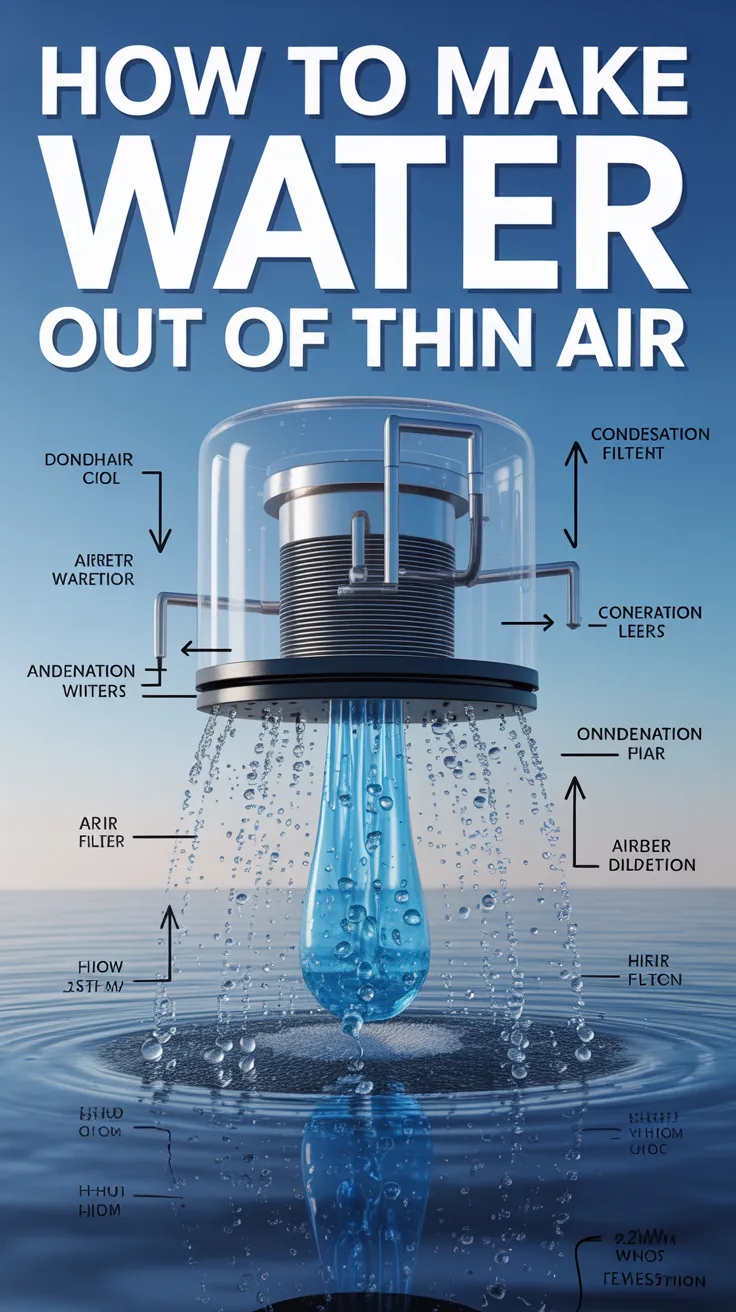
When taps run dry or you want off-grid resilience, learning how to make water out of thin air is a powerful skill. Air around you carries moisture almost everywhere on Earth; with the right techniques, you can condense or capture that humidity and turn it into drinkable water. From simple plastic-sheet solar stills to more advanced dew condensers and desiccant-based rigs, this guide covers practical methods, safety considerations, and real-world expectations. If you prefer turnkey, off-grid–friendly solutions alongside DIY, consider adding a trusted water-readiness system like Aqua Tower to your plan for fast deployment.
Table of Contents
How air becomes water and what you can realistically expect
Before you start building, it helps to understand the science. Water vapor in the atmosphere condenses when a surface is cooler than the surrounding air’s dew point. Dew point depends on temperature and relative humidity (RH): higher humidity means more water can be condensed. There are three main ways to extract water from air:
- Cooling air below its dew point (condensation on a cold surface)
- Using desiccants to absorb water, then releasing it
- Intercepting existing droplets (fog harvesting)
Expect yield to vary by climate:
- Humid tropics/coasts (70–90% RH): high potential
- Temperate climates (40–70% RH): moderate potential, best at night and early morning
- Arid zones (10–40% RH): low potential without desiccants or radiative cooling aids
Practical benchmarks:
- Simple solar stills often produce a cup or two per sunny day per square meter
- Fog nets can yield liters per square meter when fog is frequent
- Electric dehumidifier rigs can produce several liters per day, but power usage can range widely based on humidity and temperature
Always plan for purification and remineralization. Water condensed from air can be very low in minerals and may pick up contaminants from surfaces or airborne particles. You’ll learn safe, step-by-step collection and treatment below—plus how to choose which method fits your climate, budget, and goals.
The simplest foundations for atmospheric water: solar stills, transpiration bags, and fog nets
If you’re new to water-from-air, start with low-cost, low-tech methods. They teach the fundamentals and provide emergency backup.
Solar ground still (classic survival setup)
What it does: Uses sunlight to evaporate moisture from soil/plant material and condense it on plastic.
You’ll need:
- Clear plastic sheet (2–3 mil thickness)
- Container/cup
- Small stone
- Shovel
Steps:
- Dig a conical pit 18–24 inches deep with a flat spot for your cup.
- Place green vegetation around the cup to boost vapor.
- Cover with plastic, seal edges with soil, and place a small stone at the center to create a drip point over the cup.
- Leave in full sun. Condensate drips into the cup over hours.
Pros: No power; minimal materials. Cons: Slow; depends on sun and soil moisture. Tips: Use morning dew–damp soil; avoid contaminated ground; make multiple stills for more yield.
Transpiration bag
What it does: Captures moisture plants release.
You’ll need: Clear plastic bags and string.
Steps:
- Slip bags over leafy non-toxic branches (avoid poisonous species).
- Tie off the opening to seal in humidity.
- Angle bags so water collects in a corner for easier retrieval.
- Rotate bags throughout the day across several plants.
Pros: Fast setup; good in sunny areas with vegetation. Cons: Limited daily yield per bag; plant-dependent. Hygiene note: Purify before drinking.
Fog harvesting mesh
What it does: Intercepts microscopic droplets in fog and channels them to a collector.
You’ll need:
- Fog-collecting mesh (HDPE or shade cloth)
- Frame, guy lines
- Gutter and clean reservoir
Steps:
- Mount mesh vertically on a sturdy frame facing prevailing fog winds.
- Attach a drip rail/gutter at the bottom edge.
- Route to a covered container with a fine prefilter.
- Anchor against wind; elevate to reduce ground dust.
Pros: Excellent in fog-prone coasts or highlands; passive and scalable. Cons: Site-specific; needs sturdy installation and periodic cleaning.
Mid-path upgrade: Consider pairing these passive captures with modular storage or purification to make the most of every drop. A compact water-readiness companion like SmartWaterBox can help you organize filtration, storage, and field treatment without reinventing your kit.
How to make water out of thin air using dew and radiative cooling
Dew happens when surfaces radiate heat to the night sky and drop below the ambient dew point. You can amplify that effect to increase yield—no electricity required.
Radiative dew condenser
Concept: A special surface “sees” the cold night sky and cools via long-wave radiation, causing water to condense. You can build an effective DIY version:
Materials:
- Condensing panel (white or matte emissive plastic/metal; PTFE-coated aluminum works well, but any clean, non-porous sheet can start)
- Insulation (foam board) to keep the panel cool relative to air
- Frame/stand to angle the panel
- Hydrophilic coating or very clean surface for better droplet formation
- Drip rail and food-grade tubing
- Covered collection container
Build steps:
- Size and angle: A 1–2 m² panel angled 20–30° from horizontal toward the clear night sky. Avoid tree cover and nearby heat sources.
- Insulate: Back the panel with foam board to reduce heat gain from below.
- Surface prep: Clean with mild detergent; optionally use a hydrophilic coating to help micro-droplets coalesce and run off.
- Edge collection: Attach a small gutter at the lower edge and route tubing to a sealed jug below the panel’s edge.
- Night operation: Deploy at dusk, collect at sunrise. Protect from dust and insects with a screened vent near the gutter.
Enhancements:
- Wind management: Light crosswinds improve heat transfer, but strong winds warm surfaces. Use wind baffles if necessary.
- Selective surfaces: Materials optimized for thermal emissivity in the 8–13 µm band work best for radiative cooling. For DIY, cleanliness and orientation matter most.
- Scaling: Build multiple panels in parallel. Space them to prevent wind shadowing.
Expected yields: From a few ounces to over a liter per m² per night in humid, clear-sky conditions. Performance drops with clouds, wind, or low humidity.
Low-tech morning dew mop
- Lay out a clean, absorbent cloth across grasses before dawn.
- Wring into a container, then filter and disinfect.
- Simple, but surprisingly helpful in humid mornings.
Safety and treatment
- Debris, bird droppings, and dust accumulate on panels. Always filter through a fine cloth, then disinfect (boil 1 minute at a rolling boil, or use a proven chemical/UV treatment). Consider post-treatment remineralization.
How to make water out of thin air with desiccants
When humidity is low or temperature swings are large, desiccants can outperform simple condensation. They absorb water from air; you then “regenerate” them with heat to release the captured water.
Common desiccants
- Salt solutions (sodium chloride or calcium chloride): Inexpensive, widely available; calcium chloride (CaCl2) is particularly hygroscopic.
- Silica gel: Reusable beads often used in packaging; less aggressive than CaCl2 but stable and easy to handle.
- Zeolites or specialized sorbents: Advanced options used in some commercial systems.
Basic batch-cycle setup (CaCl2 brine example)
You’ll need:
- Food-grade bucket(s) with lid
- Mesh tray or perforated container for desiccant
- Airflow path (small fan optional)
- Condensation chamber or collection bowl
- Heat source for regeneration (solar oven, stovetop, or low-power electric)
Absorption cycle:
- Place desiccant in a breathable tray at the top of a sealed container; leave space inside for air exchange.
- In moderately humid air, salts absorb water and become brine. Silica gel will gain weight as it binds moisture.
- After several hours to a day (depending on humidity), seal the container and move to regeneration.
Regeneration and condensation:
- Carefully heat the brine or saturated desiccant in an enclosed vessel connected to a condenser (coiled metal tubing in cool water works).
- Collected steam condenses into a separate, clean container. Avoid boiling over or aerosol carryover of salts.
- For silica gel, follow manufacturer temperature limits (often 100–150°C) to drive off moisture; capture the released vapor via a condenser if practicable, or use a closed loop setup.
Pros and cons
- Pros: Works in dry climates; runs on low-grade heat (solar oven or biomass); scalable with multiple canisters.
- Cons: Requires careful handling to avoid contamination; more parts; slower cycle.
Safety notes
- Keep desiccants out of direct contact with the water you will drink. Use food-safe materials for the vapor path and receiving container.
- Always post-treat: Filter and disinfect condensed water. For salts, ensure no mist or splatter enters the collection jar.
Optimization tips
- Use a black-painted regeneration pot inside a reflective solar cooker to minimize fuel.
- Pre-warm intake air with sun, then cool the condenser with shade or evaporative cooling to maximize phase change.
- Alternate two sets of desiccants: one absorbing while the other regenerates, for near-continuous production.
For streamlined implementation, an integrated water-readiness kit such as SmartWaterBox can help consolidate your filtration, storage, and treatment workflow as you experiment with sorption systems.
Electric and hybrid AWG: dehumidifiers, Peltier coolers, and power planning
Electric atmospheric water generators (AWG) are essentially dehumidifiers configured for potable production. They pull air over chilled coils, condense moisture, and collect it. You can build a DIY equivalent or adapt a household dehumidifier with upgrades for safety and efficiency.
Adapting a dehumidifier
- Choose a unit with stainless or easily sanitizable collection surfaces.
- Add intake prefiltration (e.g., MERV/HEPA-grade filter) to reduce dust and microbes.
- Route the condensate directly into a closed, food-grade tank via sterile tubing.
- Post-treat with activated carbon, UV, or boil as a fail-safe.
- Clean coils and reservoir regularly with a food-safe sanitizer; prevent biofilm.
Energy expectations
- Energy per liter can range widely (roughly 0.3–1.2 kWh/L) depending on RH and temperature.
- Warmer, humid air is far more productive. In cool, dry air, power use rises.
- Solar + battery: If off-grid, size panels and storage to daily target yield (e.g., 10 L/day at 0.6 kWh/L ≈ 6 kWh/day).
Peltier (thermoelectric) modules for micro-AWG
- Great for demos or small rigs; less efficient than compressor units at scale.
- Use a heat sink and fan on the hot side; cold plate faces airflow in a duct.
- Insulate cold-side surfaces; add a drip guide to a sterile container.
- Expect milliliters to a few hundred milliliters per hour per module in favorable conditions.
Hybrid systems
- Pair radiative condensers at night with electric dehumidification by day.
- Use waste heat: Dehumidifiers produce warm exhaust; route that air for drying clothes or warming a space.
- Pre-cool intake air via shade or evaporative cooling, then chill with electric coils for higher efficiency.
Turnkey water resilience
If you prefer an off-the-shelf path instead of piecing together parts, evaluate comprehensive water-readiness solutions like Aqua Tower. While you should match any system to your climate and power budget, having a dedicated, integrated water approach can dramatically simplify setup, storage, and day-to-day operation.
Purifying, remineralizing, and safely storing your atmospheric water
Condensed water can be extremely low in dissolved minerals and vulnerable to contamination from surfaces, air, and storage. Treat, test, and store it as if it were rainwater.
Core treatment steps
- Sediment filtration: Start with a 5–20 micron filter to remove particulates if your method introduces debris.
- Disinfection: Boil (1 minute rolling boil, longer at high altitude) or use a proven chemical disinfectant per instructions. UV disinfection is effective if water is clear.
- Carbon polishing: Activated carbon can improve taste by adsorbing residual organics and odors.
Optional advanced steps
- Reverse osmosis (RO): Typically overkill for condensate but can standardize quality when blending with other sources.
- UV-C inline: Good for continuous systems; maintain lamp replacement intervals.
Remineralization for taste and health
- Add a pinch of food-grade mineral salts or use a remineralization cartridge to restore calcium, magnesium, and alkalinity.
- Target a modest mineral content; a TDS of 50–150 mg/L can improve taste without excessive salinity.
Safe storage
- Use opaque, food-grade containers with tight lids; label date and source.
- Keep out of sunlight; store cool to minimize microbial growth.
- Sanitize containers with a dilute, food-safe sanitizing solution before each fill.
- For longer-term storage, maintain a small residual disinfectant (e.g., properly dosed chlorine) and rotate stock.
Testing and monitoring
- Periodically check TDS to ensure your remineralization is consistent.
- If using air drawn from garages or polluted environments, consider VOC filtration and avoid contaminated areas entirely.
- Inspect for biofilm (slimy feel) in reservoirs and tubing; clean immediately if detected.
Integrate all steps into a simple workflow:
Capture → Prefilter air/water path → Condense → Collect in a closed vessel → Disinfect → Carbon polish → Remineralize → Store
Climate-ready setups and scaling your system
The best way to make water out of thin air for your home or campsite depends on local climate, power availability, and daily needs. Use these tailored blueprints.
Humid coastal or tropical zones
- Primary: Electric dehumidifier AWG or large radiative condensers.
- Boosters: Nighttime radiative panels + daytime electric; fog nets if fog is common.
- Power: Solar PV is viable thanks to high yield per watt; plan for thorough filtration and regular coil cleaning.
Temperate climates with seasonal swings
- Primary: Hybrid stack—dew/radiative condensers (spring/fall), dehumidifier during humid spells, desiccant rigs in dry cold.
- Boosters: Transpiration bags and morning dew capture on vegetation during peak humidity.
- Tip: Check dew point forecasts to schedule runs on the best nights.
Arid and high desert
- Primary: Desiccant-based systems with solar regeneration; radiative panels with highly emissive, well-insulated surfaces.
- Boosters: Evaporative pre-cooling of condensers (where permitted) and wind management around panels.
- Expectation: Lower yields; refine other water strategies too, like storage and conservation.
Urban apartments and small spaces
- Primary: Compact dehumidifier with high-grade intake filtration; closed, sanitized collection loop.
- Hygiene: Strict maintenance schedule; keep away from cooking vapors and cleaning chemicals.
- Security: Store treated water in opaque jugs away from heat sources.
Scaling strategies
- Parallelization: Many small panels/stations often outperform one large unit due to better airflow and surface area distribution.
- Staging: Run passive methods continuously, supplement with electric AWG during high-demand windows.
- Storage-first: Build 2–3 days of treated water storage to buffer dry spells and maintenance downtime.
For broader preparedness, round out your resilience plan with a reliable water supply strategy and day-to-day survival know-how. A resource like Joseph’s Well can complement atmospheric capture by helping you think through reliable sourcing, while guides such as URBAN Survival Code expand your skillset for city-specific challenges.
Troubleshooting, maintenance, and output optimization
Keeping your water-from-air setup productive comes down to clean surfaces, smart timing, and small design tweaks.
Common issues and fixes
- Low yield on dew/radiative rigs: Check for cloud cover and wind; increase panel tilt or add wind baffles; improve surface cleanliness and hydrophilicity; expand surface area.
- Dirty taste/odor: Replace carbon filters; sanitize coils and reservoirs; verify airtight collection path; ensure you’re not near VOC sources.
- Biofilm growth: Shorten storage time; disinfect regularly; increase residual sanitizer; use opaque tanks.
- Desiccant carryover: Use splash guards and vapor paths that minimize aerosol transport; slow boil/heat; insert a simple demister before the condenser.
- Electric inefficiency: Clean intake filters and coils; ensure proper airflow; run only in high-RH windows; pre-cool intake air.
Maintenance schedule (baseline)
- Daily/after each run: Rinse collection vessels; check for visible debris; empty and dry components if not in continuous use.
- Weekly: Sanitize tanks and tubing; swap or clean air filters; inspect seals and gaskets.
- Monthly: Deep-clean condenser coils; test TDS and taste; inspect fog nets for biofouling and tension.
- Seasonally: Recoat hydrophilic surfaces if used; recalibrate power usage vs. yield; expand or reconfigure panels for seasonal winds.
Optimization tips that often add 10–30% yield
- Timing: “Chase the dew point” by running during highest RH (pre-dawn).
- Thermal contrasts: Shade or cool condensers, insulate backsides, and keep the hot side of Peltier/compressor systems well-vented.
- Airflow: Smooth, laminar airflow across condensing surfaces reduces boundary layers and improves droplet formation.
- Cleanliness: Dust, oils, and pollen inhibit condensation; keep everything spotless.
Actionable experiment loop
- Track inputs: Ambient temperature, RH, dew point, and wind.
- Measure outputs: Liters per hour, energy per liter for powered systems.
- Adjust one variable at a time: Panel angle, airflow speed, surface coating, or timing.
- Record results to find your best “recipe” for the season.
Tools and resources to accelerate your build
Having the right tools and a few curated resources can shortcut months of trial and error.
Toolkit essentials
- Thermo-hygrometer for temperature and humidity
- TDS meter for remineralization checks
- Food-grade buckets, tubing, and opaque jerry cans
- Sanitation supplies (unscented bleach for making a proper sanitizing solution, or other food-safe sanitizers)
- Filters: 5–20 micron sediment, activated carbon block, optional UV unit
- Mesh and framing materials for fog/dew projects; foam board for insulation
- Basic solar cooker or reflective oven for desiccant regeneration
Recommended resources and solutions
- Aqua Tower: A helpful option when you want a dedicated, integrated water-readiness approach instead of a from-scratch build.
- SmartWaterBox: A compact way to organize treatment and storage for any atmospheric capture method you choose.
- Joseph’s Well: Complements air-to-water by broadening your sourcing strategy for homestead or off-grid setups.
- URBAN Survival Code: Urban-friendly preparedness tactics to pair with small-space AWG and storage.
- The Lost SuperFoods: A pantry-building companion for water resilience, helping you maintain balanced preparedness beyond hydration.
Choose options that fit your climate and capacity. Always verify materials are food-safe and that any device used for potable production is cleaned and maintained to drinking-water standards.
Quick action plan to start producing water this week
Day 1–2: Scout and plan
- Measure morning/evening RH and dew point for three days.
- Identify a clean, open-sky location for a radiative panel; note prevailing wind.
Day 3–4: Build and test a dew condenser
- Assemble a 1–2 m² insulated panel with gutter and closed collection bottle.
- Run for two clear nights; log yields.
Day 5–6: Add purification and storage
- Set up a basic filtration-disinfection-remineralization chain.
- Store 5–10 liters in opaque containers; label and date.
Day 7: Expand and optimize
- Add a second panel or a small fog mesh if conditions fit.
- If you need daytime output, evaluate a compact dehumidifier with proper intake filtration and post-treatment.
Optional upgrades
- Pilot a desiccant canister and solar regeneration loop for arid days.
- Bundle your gear into a tidy kit like SmartWaterBox to keep everything ready to deploy.
- If you need a turnkey jumpstart, explore Aqua Tower for a more integrated solution.
Conclusion
Mastering how to make water out of thin air is a blend of physics, hygiene, and practicality. Start simple with dew and solar stills, scale with fog nets or desiccant rigs, and consider electric AWG when humidity and power budgets align. No matter the method, treat and remineralize your water and keep your system spotless. With a few days of planning and the right tools, you can add a reliable source of drinking water to your home, campsite, or off-grid retreat—turning the invisible moisture around you into safe, stored hydration.
FAQ
How much water can I realistically make out of thin air each day?
It depends on humidity, temperature, and method. A small dew condenser might yield a few hundred milliliters to a liter per night per square meter in humid conditions. Fog nets can produce liters per day in foggy spots. Electric dehumidifiers can make several liters daily but require power. Always track your local RH and dew point for accurate expectations.
Is water condensed from air safe to drink?
It can be, but you must treat it. Condensed water may collect dust, microbes, and trace contaminants from surfaces or air. Use a simple treatment chain: sediment filtration, disinfection (boiling, UV, or chemical per directions), optional carbon polishing, and remineralization for taste and balance. Store in sanitized, opaque containers.
What’s the best way to make water out of thin air in a desert?
Desiccant-based systems shine in low humidity. Use calcium chloride or silica gel to absorb moisture, then regenerate with a solar cooker or other heat source and condense the released vapor. Pair with well-insulated radiative condensers for cool nights. Expect lower yields and plan extra storage and conservation.
Can I use a household dehumidifier to make drinking water?
With careful modifications and strict hygiene, some people adapt dehumidifiers for potable water. Add high-grade intake filters, use a closed, sterile collection path, and always disinfect and polish the water. Clean coils and tanks frequently to prevent biofilm. Check energy use; run during high humidity to maximize efficiency.
Which is more efficient: dew condensers or dehumidifiers?
Dew condensers are passive and use no grid power, but they depend on sky conditions and humidity. Dehumidifiers deliver more predictable, higher daily volumes in humid air, at the cost of electricity. Many households use a hybrid approach: passive nighttime capture plus powered daytime runs during humid windows.