
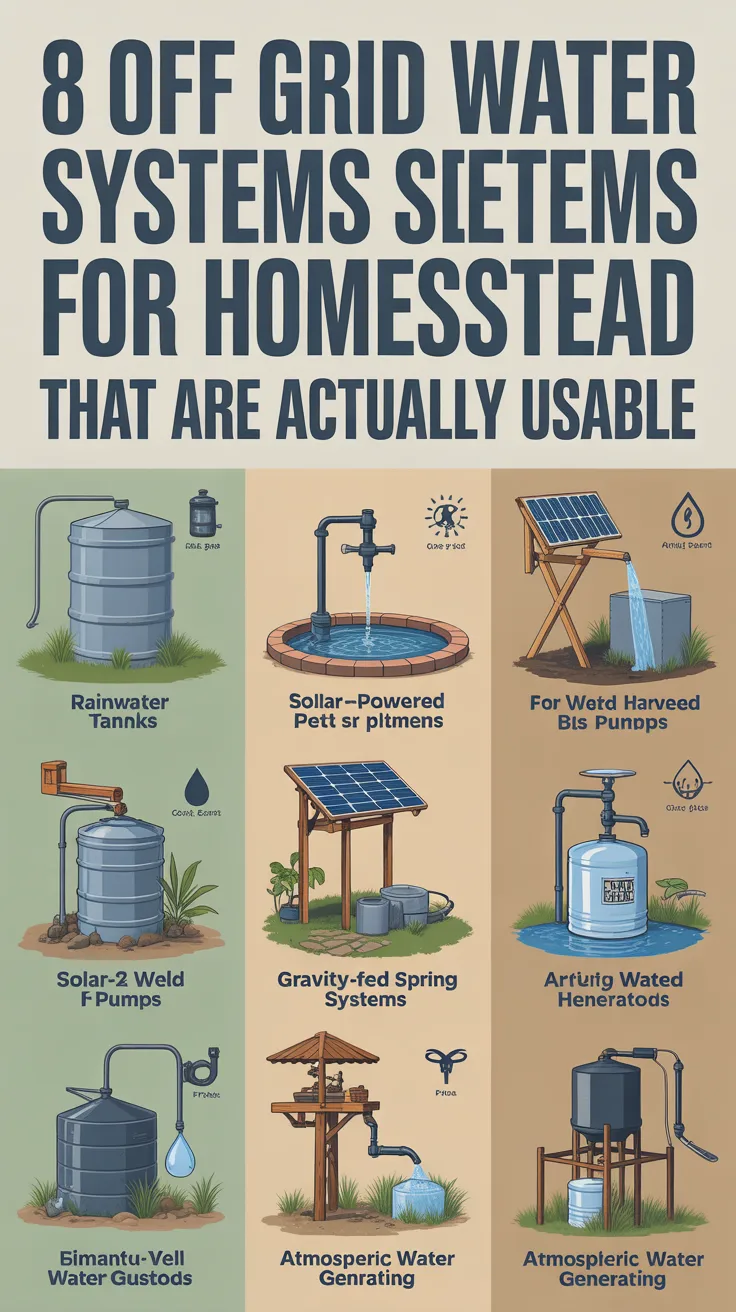
Building a reliable water setup is the backbone of any self-reliant property. The 8 off grid water systems for homestead that are actually usable below focus on practical, maintainable, and climate-aware solutions you can implement without relying on the grid. You’ll learn what each system does well, where it struggles, and how to combine them for year-round resilience.
If you want a jumpstart with a compact, off-grid-friendly approach to water collection, storage, and treatment, explore the Aqua Tower as a complementary resource to the strategies in this guide.
Table of Contents
Rainwater harvesting: one of the 8 off grid water systems for homestead that are actually usable
A roof-based rainwater harvesting system is one of the simplest ways to secure independent water on most homesteads. By converting your roof into a catchment surface and routing clean rain through gutters, screens, and a first-flush diverter into food-grade storage tanks or a buried cistern, you can bank thousands of gallons during rainy months for use through dry spells. A small transfer pump and/or elevated storage provide water pressure for taps, irrigation, and animal troughs.
Key elements:
- Catchment: metal roofing is ideal; avoid old, flaking paint and toxic materials.
- Conveyance: gutters with leaf screens, downspouts, and a first-flush diverter to keep sediment and roof grime out of storage.
- Storage: UV-stable tanks, IBC totes, or concrete/poly cisterns sized to your climate and needs.
- Treatment: sediment prefilters, activated carbon, and final disinfection (boil, UV, or other safe method) if water will be consumed.
Pros:
- Scales from a single tank to a large cistern network.
- Works even where wells are deep or unreliable.
- Water is typically soft and low in minerals, great for appliances and gardens.
Cautions:
- Seasonal variability; you need enough storage to bridge dry spells.
- Local rules may regulate rain capture; check codes and water rights.
- Requires roofing and gutter maintenance to keep turbidity and biofilm in check.
To make stored rainwater safer for cooking and drinking, a compact treatment setup helps. Keep a multi-stage kit on hand, such as the SmartWaterBox, to pair with your tanks and a basic sediment prefilter. Even if your primary use is irrigation, having a potable pathway for emergencies is smart redundancy.
Drilled wells: another of the 8 off grid water systems for homestead that are actually usable
A properly sited drilled well remains the gold standard for many rural properties. If your land overlies a dependable aquifer, a modern well can supply year-round water with minimal day-to-day oversight. The homestead-friendly twist is using manual or solar pumping so you aren’t tethered to grid electricity.
What makes it viable off-grid:
- Manual pump backup: A high-quality hand pump mounted alongside the well cap gives you water during outages or whenever you wish to conserve power. Choose a model that suits your static water level.
- Solar submersible pump: A DC brushless submersible tied to a modest solar array (with or without batteries) can move water to a cistern or elevated tank through daylight hours.
- Elevated or pressurized storage: A water tower or pressure tank smooths delivery to the house without cycling pumps constantly.
Planning considerations:
- Hydrogeology: Depth to water, recharge rates, and drawdown vary widely. Speak with local drillers and neighbors to gauge typical yields and water quality.
- Treatment: Iron, manganese, sulfur odors, hardness, and microbial issues may require filtration, softening, or disinfection. Always lab test your well before use and periodically thereafter.
- Freeze protection: Insulate pipes above frost line, protect the wellhead, and consider a drain-back or recirculation strategy for exposed lines.
If you’re exploring low-tech well options or want a primer on siting and safe extraction, see Joseph’s Well. It’s a helpful complement when you’re planning a manual or hybrid well setup without overcommitting to complex gear.
Spring development and gravity-fed distribution
If your property has a reliable spring, you can engineer one of the most elegant and resilient water systems possible: a spring box that protects the source and feeds water downhill to your house or gardens with no pump at all. Properly developed springs can deliver year-round, virtually maintenance-free service.
Core components:
- Spring box: A sealed collection basin constructed at the source to capture clean water while excluding surface runoff, soil, and wildlife.
- Intake screen and overflow: Keeps grit and debris out while letting excess bypass safely.
- Gravity main: Buried food-grade pipe (e.g., PVC or HDPE) routed downhill to a cistern or directly to fixtures. Trenching below frost depth prevents winter issues.
- Final treatment: A sediment filter and point-of-use disinfection for drinking taps ensures potability.
Why it’s so usable:
- Zero electricity at the point of delivery; gravity provides consistent pressure.
- Very low operating costs and minimal mechanical complexity.
- Less prone to contamination than open surface water when built correctly.
What to check first:
- Seasonal flow: Measure flow at different times of year to ensure it meets your household and livestock requirements.
- Legal and environmental considerations: Spring water may be subject to water rights or local regulations.
- Source protection: Maintain a clean recharge area above the spring, excluding septic drain fields and livestock to prevent bacterial contamination (e.g., E. coli, Giardia).
Many homesteaders pair a spring with a modest storage tank to buffer daily fluctuations and add redundancy. If your house is higher than the spring, a small solar pump can lift water to a header tank and restore gravity-fed convenience.
Hydraulic ram pump from creek to cistern
When you have running water and a bit of drop, a hydraulic ram pump can lift a portion of that water uphill—without electricity. It harnesses the energy of falling water to “hammer” a smaller volume to a much higher elevation, often hundreds of feet. For homesteaders with a creek or diversion channel, this is a set-it-and-forget-it workhorse.
How it operates:
- A drive pipe brings water from the source to the ram pump.
- The pump’s waste valve rapidly opens and closes, creating a pressure spike that forces a fraction of water through a check valve into a delivery line.
- The delivery line carries water uphill to a storage tank or water tower.
Strengths:
- No fuel or power required; works 24/7 as long as source water flows.
- Few moving parts and simple maintenance once tuned.
- Ideal for filling an elevated cistern that then supplies the house by gravity.
Limitations:
- Requires a specific ratio between supply head (vertical drop to pump) and delivery head (height you want to lift). More head in, more head out.
- Not suitable for intermittent trickles or completely dry summer creeks.
- Intake must be screened and sited to avoid silt, leaves, and ice.
Best practices:
- Build a solid base and secure anchoring to prevent vibration creep.
- Use robust drive and delivery pipes sized to the pump specifications.
- Include an air chamber for smoother operation and less water hammer.
- Combine with multi-barrier treatment if the creek water is used for potable needs.
Pair a ram pump with an elevated storage tank to create pressure without any electronics. For final treatment, keeping an on-hand purifier like SmartWaterBox ensures you can make that creek water safe in a pinch.
Surface water treatment with a multi-barrier approach: part of the 8 off grid water systems for homestead that are actually usable
When wells are impractical and springs elusive, a lake, pond, or river intake combined with robust filtration is a proven path to independence. The key is a multi-barrier approach that progressively removes sediment, biological contaminants, and off-tastes before final disinfection.
Typical chain:
- Intake and settling: A screened intake anchored away from the bottom reduces silt. A small settling tank or swirl separator removes heavier particles.
- Prefiltration: A washable 50–100 micron screen, then progressively tighter cartridge filters (e.g., 20 micron, then 5 micron) to reduce turbidity.
- Biological control: Options include slow sand filtration or ceramic elements that intercept pathogens. Maintain proper flow to prevent channeling.
- Activated carbon: Improves taste, odor, and removes some chemicals.
- Final disinfection: UV light, boiling, or another safe method at the point of use.
Why it’s practical:
- Works with large catchments you already have, such as farm ponds or beaver ponds upstream.
- Scalable: start with a basic line, upgrade to more flow and redundancy as needed.
- Delivers reliable non-potable water for gardens and livestock even if potable treatment is a later add-on.
Guardrails:
- Never assume surface water is potable without treatment and regular testing.
- Maintain filters on a schedule; turbidity spikes after storms require attention.
- Winterization matters: protect lines from freezing and intake from ice.
If you prefer a packaged solution for emergency potability that complements your main filters, a portable resource like SmartWaterBox can serve as your last-mile purifier when conditions change suddenly.
Windmill and mechanical pumping to elevated storage
Long before solar panels, homesteads used wind power to lift water from wells and ponds. A windmill-driven piston pump remains a remarkably effective off-grid system, especially where steady wind and shallow to moderate water depths coincide.
System architecture:
- Tower and rotor: The windmill atop a sturdy tower turns a crank mechanism.
- Rod and cylinder: Mechanical linkage drives a pump cylinder down in the well or at the water source, lifting water with each stroke.
- Elevated storage: Water is delivered to a tank or water tower; gravity provides household pressure.
Advantages for homesteads:
- Operates with no electrical components, wiring, or inverters.
- Wind often complements solar (windy nights, stormy days), creating resilience when paired with solar pumping.
- With a properly sized tank, intermittent wind still meets daily needs.
What to consider:
- Siting: You need clear wind exposure and a tower tall enough to rise above turbulence.
- Depth and flow: Each windmill has limits on pumping depth and volume; work with local installers or farmer neighbors to match your conditions.
- Maintenance: Regular lubrication, bolt checks, and occasional part replacements keep it humming for decades.
- Freeze protection: In cold regions, drain-back or buried lines prevent icing; a ground-level cylinder may simplify service.
A hybrid approach—wind to fill the tank and a small solar pump to top off during calm spells—provides outstanding redundancy. Add a simple inline sediment filter and a cleanable screen at the source to protect valves and fixtures.
Atmospheric water generators as a supplemental off-grid source
An atmospheric water generator (AWG) condenses water vapor from air. While not a first-line solution everywhere, in warm, humid climates an AWG powered by solar or wind can supplement your primary source, especially for drinking and cooking.
When it’s actually usable:
- Relative humidity is consistently high, especially nights and mornings.
- You have sufficient renewable power capacity for the device’s compressor and fans.
- You’re seeking modest daily volumes to reduce strain on tanks or to bridge dry periods.
Integration tips:
- Set AWG output to flow into a dedicated potable container with a post-carbon polish and periodic sanitizing.
- Operate during peak humidity hours to maximize yield per watt.
- In dry seasons, treat AWG as a secondary source and rely on harvested rain or well water.
Tradeoffs:
- Output varies dramatically with climate; yields drop in arid or cold regions.
- Electrical draw is nontrivial; oversize your solar array and consider direct daytime operation without batteries.
- Filters and lines need sanitation on a set schedule to maintain safety.
Used wisely, an AWG functions like a “drinking water generator” that lessens the burden on your main storage. Keep expectations realistic, and anchor your homestead supply on one or two primary systems (e.g., rain + well) with AWG as the flexible add-on.
Greywater recycling and pressure via a simple water tower
Stretching your potable supply is as important as creating it. A greywater system routes lightly used water from showers, bathroom sinks, and laundry (not kitchen sinks or toilets) to irrigation zones or subsurface mulch basins. Pairing conservation with an elevated storage tank or small water tower yields consistent pressure for non-potable uses without cycling pumps.
Greywater basics:
- Source separation: Collect from approved fixtures only; exclude kitchen/food prep drains due to fats and pathogens.
- Simple treatment: A hair/lint filter and a surge tank help settle particles.
- Distribution: Subsurface delivery to trees and perennials prevents odors and human contact; follow local codes.
Why it’s a “usable” off-grid system:
- Reduces daily demand on your potable tanks by a large margin, especially in summer.
- Increases drought resilience by keeping landscape and orchard watered with water you’ve already paid to heat and carry.
- Low energy; gravity-fed distribution from a header tank minimizes pump run time.
Water tower synergy:
- Fill an elevated tank (even a modest 200–500 gallons) via solar pump during daylight.
- Use gravity for garden spigots, drip lines, and livestock—no inverter needed.
- A simple mechanical float valve keeps the tank topped off when power is available.
If you prefer a guided pathway to assembling a compact off-grid setup, a resource like the Aqua Tower can complement your greywater and storage plans, especially when you want pressure without complexity.
How to combine systems for year-round reliability
No single system is perfect. The most resilient homesteads combine two primary sources and at least one backup, then layer in storage and treatment.
Proven combos:
- Rainwater + well: Use solar to pump well water to a cistern; keep rain for domestic hot water and laundry to reduce hardness issues.
- Spring + gravity + emergency purifier: Nearly set-and-forget for most daily use, with a final disinfection option during high runoff.
- Creek + ram pump + elevated tank + multi-barrier treatment: Store high and clean as needed.
- Windmill + solar pump: Let wind do the heavy lifting, solar top-up on calm days.
Critical practices across all systems:
- Test, then treat: Lab test your source periodically. Use a multi-barrier approach and point-of-use disinfection for drinking taps.
- Sanitation routine: Replace or clean filters on a schedule; shock sanitize tanks and lines when needed.
- Freeze protection: Bury lines below frost depth, insulate exposed pipes, and plan for drain-back where appropriate.
- Redundancy: Keep a manual pump or a gravity option as a last resort; store at least several days of potable water per person.
Preparedness extras:
- A pantry plan improves water efficiency (e.g., dehydrated and shelf-stable foods). For broader self-reliance, see The Lost SuperFoods as a complementary food resilience resource to your water strategy.
Quick action checklist and CTA
- Identify your primary and secondary water sources based on your climate and site.
- Decide on storage (cistern or elevated tank) and minimum capacity to bridge your longest dry spell.
- Choose a treatment chain that fits your source’s risks and your household’s needs.
- Build in a manual or gravity backup so water still flows when power is down.
Want a straightforward path to implementing these ideas? Consider:
- A compact, off-grid-friendly setup like the Aqua Tower to unify collection, storage, and delivery.
- A practical well-planning resource such as Joseph’s Well if you’re evaluating manual or hybrid well options.
- A portable purifier like SmartWaterBox to complete your multi-barrier treatment.
Recommended tools and resources
- Aqua Tower — a compact resource to help you organize off-grid water collection, storage, and delivery.
- Joseph’s Well — guidance for planning and implementing low-tech or hybrid well solutions.
- SmartWaterBox — a portable purification option to backstop your main filters.
- The Lost SuperFoods — a food resilience companion to reduce water strain during disruptions.
Conclusion
Choosing among the 8 off grid water systems for homestead that are actually usable comes down to matching your climate, terrain, and daily demand with the right combination of source, storage, and treatment. For many properties, a rainwater system plus a well or spring offers dependable coverage; others thrive with a ram pump and elevated storage or a windmill hybrid. Regardless of your path, prioritize a multi-barrier purification plan, winterization, and redundancy. Build in gravity whenever possible, keep a portable purifier on hand, and maintain your lines and tanks on a schedule. The result is the one thing every homestead needs: water that flows, even when the grid doesn’t.
FAQ
What’s the best off-grid water system for a small homestead?
It depends on your site. Rainwater plus a modest cistern is often the easiest starting point. Add a compact purifier for potable use, and consider a secondary source (well, spring, or surface intake) for redundancy.Do I need to treat rainwater before drinking it?
Yes. Even clean roofs can harbor dust, pollen, and bird droppings. Use a first-flush diverter, sediment/carbon filtration, and final disinfection (boiling, UV, or another safe method), and test periodically.How much storage should I plan for?
Work backward from daily demand and your longest expected dry spell. Many homesteads aim for a minimum of several weeks of essential use, plus separate potable reserves.Are atmospheric water generators practical everywhere?
No. They’re most useful in warm, humid climates and as a supplemental source. In arid or cold regions, prioritize rainwater, wells, springs, or surface water with filtration.How do I get water pressure off-grid?
Use elevated storage (a water tower) for gravity-fed pressure or a small pressure tank with a solar pump. Gravity systems are simpler and reduce pump cycling and power needs.