
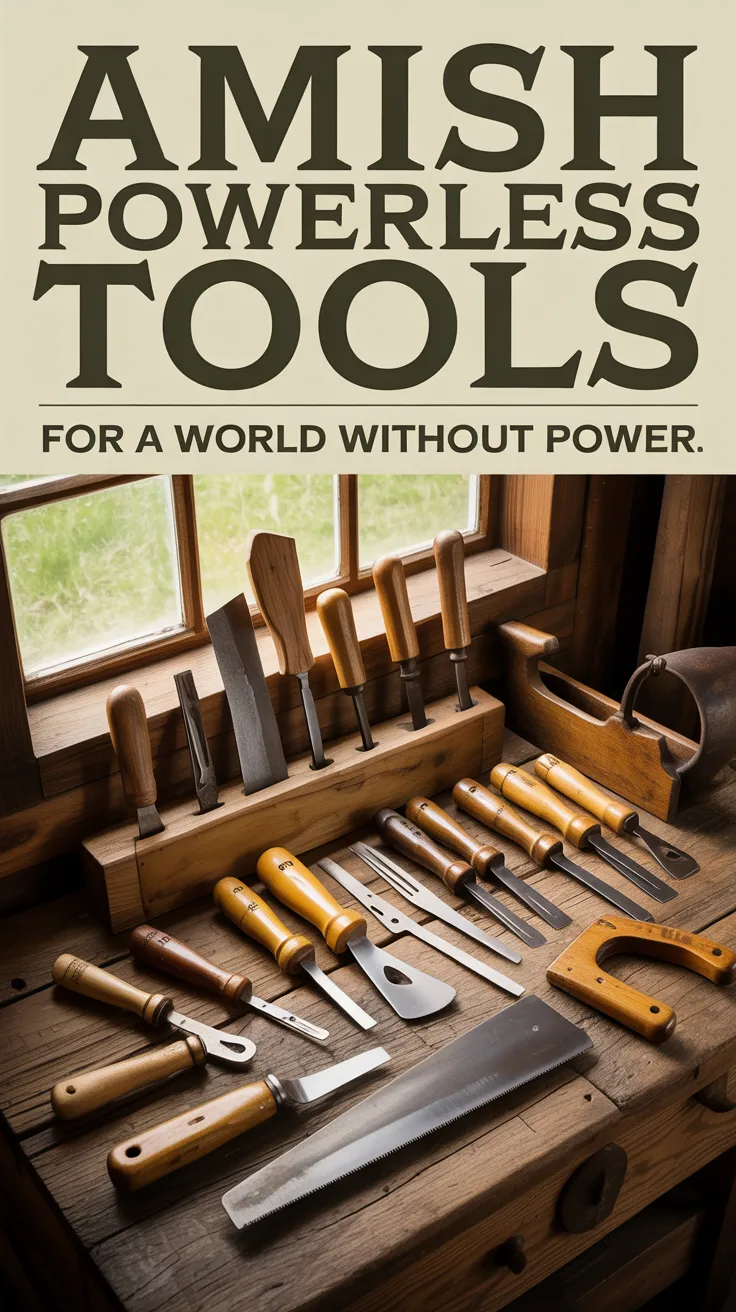
When the lights go out, life doesn’t have to stop. The Amish have quietly perfected a practical, dignified way of living that works with muscle, wind, water, and fire—no outlets required. Studying Amish powerless tools for a world without power doesn’t mean rejecting modern life; it means reclaiming skills and gear that keep families fed, warm, productive, and connected when electricity isn’t guaranteed. If you’re building an off-grid toolkit, a prepper pantry, or simply want to be more self-reliant, the Amish playbook offers a blueprint that is simple, durable, and proven.
To begin building food resilience grounded in timeless methods, explore The Lost SuperFoods—classic staples and preservation methods that complement any powerless toolkit: The Lost SuperFoods.
Table of Contents
Amish resilience as a model for living without electricity
The Amish didn’t set out to become icons of preparedness; their approach is rooted in values that incidentally produce resilience. The principles behind their lifestyle translate into actionable steps for anyone preparing for grid disruptions, downed lines, or long-term off-grid living.
Core principles you can adopt:
- Simplicity first: Choose tools you can power, maintain, and repair with your hands. Every complex system invites complex failure.
- Redundancy over convenience: A hand-powered option for every critical task—water, food, heat, light, sanitation—gives you margin when the grid is down.
- Repairability is king: Prefer tools made of wood and steel with standard fasteners, sharpenable edges, and replaceable parts. No microchips required.
- Local energy cycles: Use gravity, sun, wood, and water where possible. Amish homesteads nudge tasks to fit daylight and seasonal energy patterns.
- Skills beat gadgets: Knowledge multiplies your gear. A scythe in skilled hands beats an empty gas can.
Embracing an Amish-inspired mindset reorients how you plan. You replace “What gadget solves this?” with “What process solves this forever?” That shift transforms your shopping list and your daily rhythms.
You don’t need to mimic Amish culture to apply the lessons. Urban dwellers, suburban gardeners, and rural homesteaders can all assemble a core kit of powerless tools, organize workspaces for human-powered efficiency, and learn a handful of evergreen skills that carry communities through blackouts and beyond.
In the rest of this guide, you’ll find a structured look at proven Amish powerless tools for a world without power—what to choose, how to use them, and why they belong in your resilience plan.
Hand tools that replace electricity in the workshop and field
The backbone of a powerless life is a curated set of hand tools that do what corded and battery tools do—just more quietly. Focus on multi-use tools with a high return on skill.
Foundational cutting and shaping tools:
- Two-man crosscut saw or a quality bow saw for felling and bucking. Paired with wedges and a filing kit, you can harvest and manage firewood indefinitely.
- A scythe or a sturdy grass sickle for cutting pasture, ditch banks, and mulch—safer and quieter than string trimmers.
- Axes and hatchets for splitting, trimming, and joinery. Add a maul for serious rounds and kindling splits.
- Drawknife and spokeshave for shaping handles, pegs, tool parts, and furniture components with unmatched control.
- Hand planes (jack, smoothing, and block) to true and finish wood surfaces without a sander. A sharp plane turns a rough board into a finished surface.
- Chisels, mallet, and a brace-and-bit with augers for joinery, hinge mortises, and boring holes—no drill batteries required.
Joinery and fastening essentials:
- A brace with a set of bits (spade, auger, countersink) gives precise control for furniture and repairs.
- Hand saws: a rip saw for cutting with the grain, a crosscut for across it, and a backsaw for joinery.
- Files and rasps for metal and wood shaping, edge dressing, and tool maintenance.
- Hand-cranked grindstone or small sharpening stones to keep edges keen; sharpness is the real force multiplier.
Rigging and lifting aids:
- A block-and-tackle set or a simple gin-pole helps hoist beams, engines, or windmill heads without powered equipment.
- Rope, webbing, and pegs for secure lashing and adaptable temporary structures.
Care and organization:
- Maintain a dedicated tool wall or chest with rust control (oil and wax), a sharpening kit, spare handles, and hardware. The Amish value order; a place for each tool speeds work and reduces loss.
- Learn basic handle fitting, wedge setting, and saw sharpening. Your tools become a lifetime investment rather than disposable items.
With these tools, you can construct shelters, build furniture, repair farm implements, and keep firewood flowing—core tasks the grid can never automate for you.
Amish powerless tools for water and sanitation
Water is non-negotiable. Amish homesteads are often anchored by simple, sturdy systems for lifting, storing, and purifying water that continue working in every outage. This is where a few well-chosen powerless tools can carry a household through weeks or years.
Proven capture and lift methods:
- Hand pump or pitcher pump on a shallow well provides reliable daily draw with minimal maintenance.
- Windlass and bucket on a deep well is as fail-proof as it gets—a rope, a wheel, a bucket, and gravity.
- Rain catchment barrels with first-flush diverters turn every downspout into a steady reserve for gardens and non-potable uses. Use food-grade barrels and mosquito screens.
Storage and plumbing that work without power:
- Elevated cisterns create gravity-fed pressure for sinks and outdoor spigots. Place on a sturdy platform and use thick-walled piping to reduce freeze risk.
- Gravity filters and ceramic elements make non-chlorinated sources potable without pumps.
- Manual transfer pumps, siphons, and hand-operated valves simplify moving water between containers.
Sanitation and graywater:
- Dry toilets and well-managed composting systems keep waste safe without flushing. Keep carbon cover material (sawdust, leaves) stocked.
- Graywater from laundry and dishes can be routed to landscape basins with simple piping and filters.
To accelerate your water independence, consider simple, non-electric systems designed for emergencies and homestead daily use:
- For fast deployment of a gravity-fed, off-grid water supply, a compact tower system is easy to set and maintain: Aqua Tower.
- If you’re planning for a well-centric setup, explore methods for resilient well access and emergency pumping: Joseph’s Well.
- For modular water storage and filtration that fits small spaces, a portable, stackable option can keep families supplied: New Water Offer: SmartWaterBox.
No matter what you choose, aim for three layers:
- On-site potable storage,
- A way to produce more daily, and
- A reliable method to purify.
Couple those with a daily water discipline—measuring use, rotating storage, and protecting containers from light and heat—and you’ll turn water from a vulnerability into quiet confidence.
Food production and preservation with human-powered tools
The Amish keep pantries deep by aligning tools, crops, and preservation. Your goal is the same: steady calories, seasonal abundance, and shelf-stable staples that don’t need a plug.
Grow with simple, effective tools:
- A broadfork aerates beds without inverting soil; hoes and wheel hoes handle weeding; a hand seeder sets rows faster than you think.
- Garden knives, pruning saws, and loppers maintain fruit trees and canes. Hand pruners are your best friends.
- A sturdy garden cart or wheelbarrow multiplies muscle, moving compost, wood, and harvests efficiently.
Turn harvests into shelf-stable wealth:
- Manual grain mills transform wheat, corn, and oats into flour and meal on demand—fresher and more nutritious than bagged flour.
- Hand-crank meat grinders, sausage stuffers, and jerky racks convert seasonal meat into staples.
- Butter churns and hand whisks preserve dairy as butter and cultured products.
- Fermentation crocks and jars make sauerkraut, kimchi, pickles, and beverages naturally; no electricity needed.
- Canning over a wood or gas cooktop with a dial-gauge or weighted canner safely stores soups, meats, and vegetables. Keep tested recipes and elevation adjustments at hand.
- Dehydration can be solar-assisted with mesh racks and good airflow. Pair with rodent-proof, airtight storage.
Store intelligently:
- Root cellars (or even a cool corner with vented crates) stretch harvests—potatoes, carrots, apples, and cabbages last for months with proper humidity.
- Dry storage in mylar-lined buckets with oxygen absorbers protects grains, beans, and flours.
- Label every container with contents and dates, and rotate stock.
If you’re new to building a deep pantry with time-tested recipes, a curated guide of durable, low-power foods can jumpstart your plan. Explore classic staples and preservation approaches in The Lost SuperFoods—a natural complement to an Amish-inspired pantry.
A resilient food system is built on rhythm: weekly bake days, seasonal canning, and routine garden care. The reward is a home that eats well without the hum of a compressor or the blink of a microwave.
Heating, cooking, and lighting the Amish way
Comfort without electricity depends on heat, flame control, and safe illumination. Amish homes use wood, kerosene, and smart insulation to stay warm and productive.
Heat and cook with solid fuels:
- Wood stoves and cookstoves are the heart of an off-grid home. Learn to season wood (12–24 months for hardwoods), manage airflow, and maintain chimneys.
- A cookstove with an oven gives you bread, roasts, and hot water without propane or power.
- Rocket stoves and chimney-less outdoor cookers provide efficient, quick cooking with small-diameter fuel—great for summer when you don’t want extra heat inside.
- Haybox or “retained heat” cookers let you simmer stews and grains with a fraction of the fuel: bring to a boil, nest the pot in insulated bedding, and let time do the rest.
Light safely and effectively:
- Kerosene lamps and lanterns offer bright, adjustable light. Pair with reflectors and mirror backs to multiply output.
- Beeswax and tallow candles are renewable; use heavy, stable holders and glass chimneys to reduce drafts and soot.
- Light-colored walls, clean chimneys, and well-placed mirrors maximize every lumen.
Heat management and safety:
- Draft stoppers, heavy curtains, and door snakes cut heat loss in winter.
- Carbon monoxide and smoke awareness is crucial; maintain flues and keep extinguishers accessible.
- Fire tools—ash shovel, tongs, gloves—and a metal ash bucket are non-negotiable.
Water heating without power:
- Kettle on the stove, side-arm or on-stove water heaters, and black-painted solar batch heaters provide dish and bath water.
- For bathing, galvanized tubs are simple and durable; conserve hot water by washing “top to tail.”
A final Amish lesson: schedule high-energy tasks—baking, laundering, canning—when you’re already heating the stove. In summer, cook outside or early to keep homes cool. These rhythms reduce fuel use and make powerless living comfortable, not just survivable.
Clothing, repair, and small manufacturing with treadle power
In a powerless home, repair and fabrication matter as much as production. Amish shops and homes lean on foot- and hand-powered machines that transform raw materials into durable goods.
Sewing and textiles:
- Treadle sewing machines convert foot power into beautiful stitches, repairing workwear and making new garments without a single watt. They also handle canvas, denim, and leather with the right needles.
- Fabric shears, rotary cutters, and hand needles extend the sewing station. Keep thread, buttons, zippers, and patches organized in tins and cards.
- Clothes washing can be done with a hand agitator, a washtub, and a clothes wringer. Paired with a sturdy clothesline and wooden pins, you can run “laundry day” in any weather.
Leather and shoe repair:
- A cobbler’s last, stitching awls, punches, and rivets keep boots and belts alive. Leather scraps become patches, sheaths, and straps.
- Beeswax, tallow, and neatsfoot oil preserve leather through wet seasons.
Wood and metalwork:
- Shavehorse, froe, and splitting wedges produce shingles, tool handles, and chair parts.
- A hand-crank or treadle lathe (or even a simple pole lathe) turns spindles and knobs for furniture and fixtures.
- Blacksmithing with a hand-cranked blower or bellows and a small forge lets you straighten nails, forge hooks and hinges, and heat-treat small tools.
Adhesives and finishes:
- Hide glue and shellac are classic, repairable finishes that cure without power and can be renewed later.
- Linseed oil and wax protect wood and metal.
Organization for throughput:
- A sturdy bench with bench dogs and a vise anchors the workspace.
- Shadow boards (outlines for each tool) keep everything accountable. Amish shops waste little time hunting for gear.
One more Amish insight: make it beautiful. When tools and spaces are pleasing, maintenance is intuitive and daily use becomes a joy—an underrated form of resilience.
Health, communications, and community coordination off the grid
Amish communities handle health and coordination with preparedness, not panic. You can blend the same discipline with modern knowledge that doesn’t require electricity.
Health and first aid:
- Build a robust at-home kit: bandages, gauze, wraps, antiseptics, OTC pain relievers, a thermometer, tweezers, irrigation syringes, splints, and a manual blood pressure cuff.
- Learn wound cleaning, bandaging, and when to escalate care. Track medications with paper logs.
- Keep herbal basics you actually know how to use—calendula salve, arnica gel, peppermint and ginger for digestion.
- For practical, household-level guidance on handling common issues when care is delayed, a layperson-friendly manual helps. See Home Doctor for strategies to manage health challenges when you must bridge time at home.
Communications and coordination:
- Paper-based systems—family calendars, chore boards, message ledgers—keep households synced without apps.
- Bicycle or foot couriers can move messages and small goods reliably in neighborhoods and small towns.
- Prearranged meeting points and time windows provide structure if phones fail—think churchyard at noon, town square at 6 p.m.
- Hand-crank or battery radios offer weather and emergency updates. Even if Amish families avoid certain tech, the principle holds: choose tools that work without the grid.
Urban application:
- In cities and suburbs, powerless living leans on community agreements, secure water storage, shared cook sites, and stair-climbing carts.
- Learn low-profile, practical steps to get through disruptions in tight spaces: New Survival Offer: URBAN Survival Code.
Community runs on trust and routines. Practice drills—“lights-out dinner,” “water-only laundry,” or “no-fridge weekend”—to turn theory into muscle memory. The goal is calm competence, not constant alertness.
Building your Amish powerless toolkit for a world without power
You don’t need a barn-raising to start. Begin with the top five vulnerabilities—water, food, heat, light, sanitation—and add tools that unlock multiple tasks. Then develop routines that make those tools second nature.
Step-by-step starter plan:
- Water: Install rain barrels and acquire a gravity filter. Add a hand pump if you have a well. Evaluate elevated storage for gravity-fed flow. Consider a ready-to-deploy solution like Aqua Tower or compact storage like SmartWaterBox.
- Food: Buy a manual grain mill, a hand-crank grinder, and canning gear. Start with one staple recipe per week. Deepen pantry knowledge with The Lost SuperFoods.
- Heat and light: Service your chimney, stock fuel, and acquire lanterns and safe storage. Add a haybox for efficient cooking.
- Tools: Assemble a basic kit—saws, axes, planes, chisels, brace-and-bit—and a sharpening setup. Practice sharpening until it’s automatic.
- Health: Build a home medical shelf and learn a few core protocols. A practical reference like Home Doctor turns gear into capability.
Training blocks to build skill:
- Wood day: cut, split, and stack, then cook on wood.
- Water day: run solely on stored and filtered water.
- Pantry day: cook entirely from shelf-stable ingredients.
- Silent evening: work and dine by lanterns and candles.
If you want a compact framework to think through longer disruptions with simple, actionable checklists, consider a no-frills survival primer: New Survival Offer: Dark Reset. Use it to audit weak points and prioritize fixes.
Resilience isn’t a shopping spree—it’s a practice. A few sturdy tools, maintained and used weekly, outrun closets full of gadgets you’ve never tested.
Recommended powerless-friendly resources
These resources pair well with Amish-style systems and help you build capability without depending on modern infrastructure:
- Water independence and gravity-fed supply: Aqua Tower
- Well access and emergency pumping: Joseph’s Well
- Compact modular water storage and filtration: New Water Offer: SmartWaterBox
- Pantry depth and timeless staples: The Lost SuperFoods
- At-home medical guidance when care is delayed: Home Doctor
- Urban-minded preparedness in small spaces: New Survival Offer: URBAN Survival Code
- Practical disruption planning checklists: New Survival Offer: Dark Reset
Choose the one or two that address your biggest immediate gaps. Build slowly, test often, and document your systems so the whole household can run them.
Conclusion
Power outages don’t have to be crises. The Amish show that simple, robust systems and hand-powered tools can keep homes thriving for generations. By adopting Amish powerless tools for a world without power—hand pumps and gravity filters for water, manual mills and canning for food, wood stoves and lanterns for comfort, and treadle and hand tools for repair—you convert vulnerabilities into well-practiced routines. Start with water, food, heat, light, and health. Add the tools, then add the skills. In a year, you’ll look around your home and realize you’ve built more than a kit—you’ve built confidence.
FAQ
What are Amish powerless tools for a world without power?
They are hand-powered or gravity-driven tools and systems—like hand pumps, crosscut saws, grain mills, treadle sewing machines, and wood stoves—that let you handle water, food, heating, lighting, and repairs without electricity.How do I start assembling a basic Amish-inspired toolkit?
Begin with water and food: a gravity filter, rain barrels, a manual grain mill, and canning gear. Add a bow saw, axe, brace-and-bit, and a sharpening kit. Practice with weekly “off-grid” tasks to build skill and confidence.Are Amish tools better than modern electric tools?
They’re better for resilience. Electric tools are faster in normal times, but Amish-style tools keep working through outages, are easier to maintain, and often last longer because they’re repairable and simpler.How can I store water safely without power?
Use food-grade containers, store in a cool, dark place, rotate regularly, and pair storage with a purification method. Elevated tanks provide gravity-fed pressure for sinks and outdoor taps. For compact setups, consider modular options like New Water Offer: SmartWaterBox.What medical preparations fit a powerless home?
Keep a comprehensive first aid kit, paper instructions, and basic diagnostic tools like a manual BP cuff and thermometer. Learn wound care and medication management. A practical reference such as Home Doctor can guide decisions when professional care is delayed.