
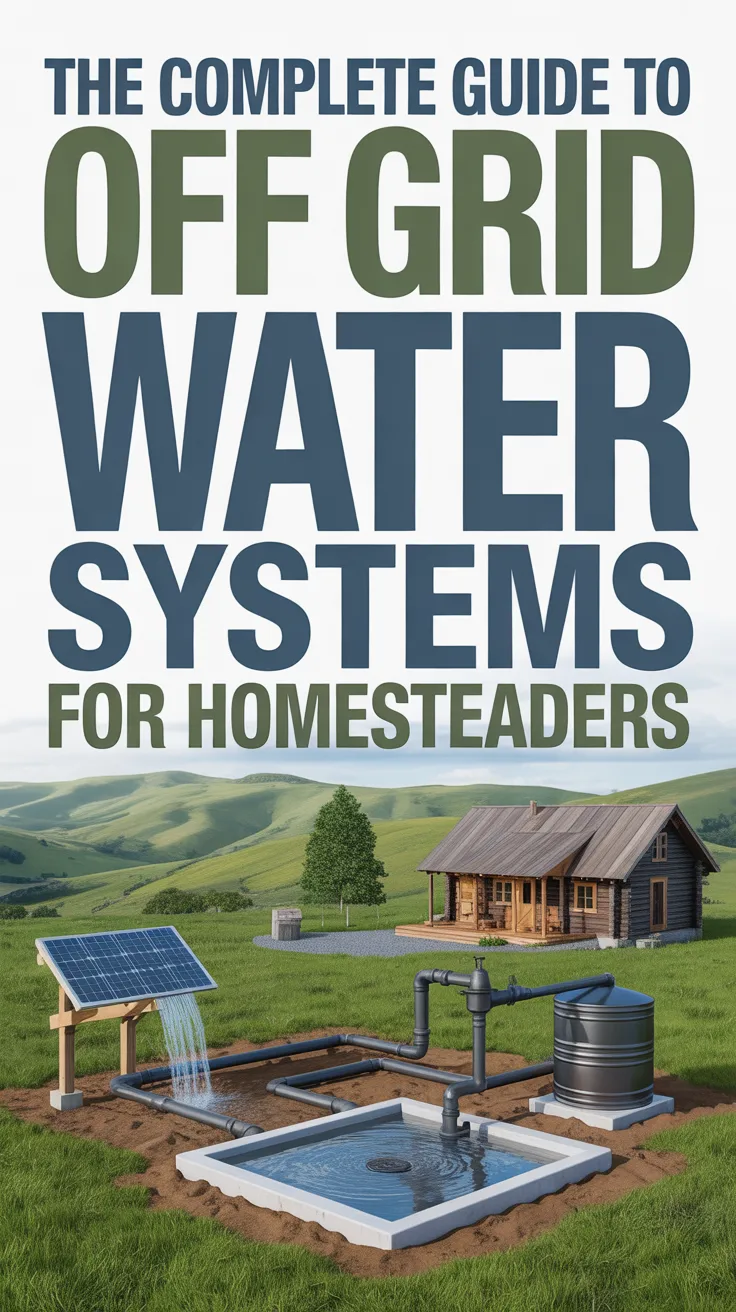
Building a resilient homestead starts with water. The Complete Guide to Off Grid Water Systems for Homesteaders walks you through assessing your needs, choosing a reliable source, designing safe collection and storage, and powering it all without the grid. Whether you’re rain-harvesting, tapping a spring, or drilling a well, this guide shows how to create a dependable, year‑round supply that protects your family and your land.
Note: This guide contains affiliate links. If you purchase through them, we may earn a commission at no extra cost to you, which helps support free resources like this.
Consider a compact, easy‑to‑deploy option like the Aqua Tower to secure drinking water fast while you build out your permanent system.
Table of Contents
Planning off grid water systems for your homestead
An off‑grid water plan begins with clear goals and constraints. Start with demand. Estimate daily use for drinking, cooking, hygiene, laundry, livestock, garden irrigation, and cleaning. A resilient homestead often targets 15–30 gallons per person per day for indoor needs, plus dedicated volumes for animals and garden. Track seasonal spikes (garden season, canning, summer guests) and reductions (winter irrigation stops). Put numbers on paper; design decisions flow from this.
Map your site. Note roof areas, prevailing winds, slopes, freeze depth (frost line), shaded vs sunny spots, soil type, and the highest point you can place a storage tank for gravity feed. Identify candidate water sources: roofs for rainwater harvesting, seasonal streams, potential well sites, or springs. Consider access roads for tank delivery and well drilling rigs, trench paths for buried water lines (below frost line), and safe locations for cisterns or spring boxes.
Account for climate. In arid regions, plan for lower rainfall capture and larger storage. In cold climates, emphasize freeze protection with burial depth, insulation, heat trace, drain‑back loops, and frost‑free hydrants. In areas with heavy leaf fall or dust, size and maintain prefilters more aggressively.
Know your legal landscape. Water rights, well permits, rainwater rules, and surface water diversion permits vary widely. Contact your county extension, state water resources department, and local health department. Ask about setbacks for wells (from septic fields, livestock pens, fuel tanks), required testing, and treatment standards for potable systems. Designing to code protects your health and preserves property value.
Set performance priorities. For example:
- Potable water quality first (multi‑stage filtration + disinfection).
- Redundancy (two sources or backup treatment).
- Low energy use (gravity‑fed when possible).
- Maintainability (standard parts, easy access, spare filters on hand).
Finally, decide what you’ll build now vs phase over time. A common path is: start with rainwater + filtration for household use, add a shallow well or spring tap for backup, then expand storage and distribution as you grow.
Choosing the right source: wells, rainwater, springs, and surface water
Most off‑grid homesteads rely on one primary source plus a backup. Each option has pros, tradeoffs, and region‑specific considerations.
Wells (drilled or driven). A properly sited and constructed well provides a protected supply from an aquifer. Advantages: year‑round availability and good baseline quality when casing and sanitary seal are correct. Tradeoffs: upfront cost and power requirement for pumping. Site wells uphill from septic and livestock areas, maintaining mandated setbacks. Test new wells for coliform/E. coli, nitrates, pH, hardness, iron/manganese, and TDS. Keep a sanitary well cap, intact casing, and a concrete apron to shed runoff. If you’re researching how to locate, develop, or maintain a well on rural land, a practical guide like Joseph’s Well can complement local professional advice.
Rainwater harvesting. Roofs are efficient collectors; metal roofs are best for low contamination. Install gutters, leaf guards, and a first‑flush diverter to route the dustiest initial runoff away from the tank. Choose opaque, food‑grade tanks or concrete cisterns to limit algae growth. Major benefits: low dissolved solids, minimal pumping if your tank is elevated, and easy scaling as roof area or tank count grows. Rainwater quality is variable—expect bird droppings and roof dust—so plan for sediment filtration and disinfection before potable use.
Springs. A perennial spring with reliable flow can be a goldmine. Box the spring (spring box) at the source to exclude surface contaminants, install an overflow, and route water by gravity to storage. Test quality across seasons; springs can change after heavy rains or droughts. Protect the recharge area (no livestock access, careful land disturbance).
Surface water (streams, ponds). These are excellent for irrigation and livestock but require robust treatment for household use due to turbidity and biological load. Use an intake with a coarse screen, locate it away from bottom silt, and set up a silt trap. Expect multi‑stage filtration and constant diligence after storms.
Combining sources increases resilience. For example, use rainwater as your primary household source and maintain a well or spring connection as backup. Or, reserve surface water for gardens and livestock while protecting potable supplies from cross‑contamination. Be mindful of legal rights when diverting or storing surface water, and install backflow prevention wherever sources can intersect.
Capturing and storing water with resilient infrastructure
Your collection and storage strategy sets the backbone of off grid water systems for homesteaders. Design for clean capture, adequate capacity, overflow safety, pest control, and freeze resistance.
Collection hardware. For rain harvesting, use seamless gutters sized to your rainfall intensity, downspout leaf guards, and a first‑flush diverter. The diverter (with an automatic ball or drain) captures the initial dirty runoff and reduces the load on downstream filters. For spring or stream intakes, elevate the intake above the bottom, use a screened foot valve, and include a silt trap basin so heavy particles settle before water enters storage.
Storage options. Common choices include:
- Polyethylene tanks (opaque, UV‑resistant, food‑grade) in 500–5,000+ gallons, placed on compacted, level pads.
- Buried concrete cisterns (freeze‑proof, protected from UV and temperature swings).
- Modular IBC totes for budget‑conscious builds (use food‑grade and shield from sunlight).
Sizing storage. Match tank volume to demand, rainfall pattern, and source reliability. Long dry spells call for more storage; steady wells need less. As a rule of thumb, larger storage improves resilience and reduces pump cycling. If possible, locate at least one tank uphill to enable gravity feed to the house, which saves energy and provides water during power interruptions.
Plumbing and safety. Use potable‑rated PEX or PVC (appropriate schedule and temperature rating). Install a tank inlet with calming inlet (to minimize stirring up sediment), an accessible cleanout, and a screened vent to prevent vacuum. A float valve can prevent overfilling when gravity‑fed; an overflow routed to daylight prevents erosion. Include unions and valves so you can isolate sections for maintenance. Keep tanks shaded or insulated to reduce biological growth and freeze risk. In bear, raccoon, or rodent country, protect external lines and vents with metal mesh.
Freeze protection. In cold climates, bury lines below frost depth, insulate exposed segments, and use heat tape where necessary with GFCI protection. Design drain‑back options for lines feeding outdoor hydrants or outbuildings. Frost‑free hydrants and deep burial keep yard water points functional through winter.
Maintenance access. Build in inspection ports and sediment drains. Plan for annual tank inspection, sediment removal when needed, and replacement of gaskets and screens before they fail. Good storage design reduces the burden on downstream filtration, extending filter life and improving taste.
Treatment options for off grid water systems
Safe drinking water relies on a treatment train matched to your source. Think of treatment as layers: remove particles, remove tastes/odors, then disinfect.
Typical sequence:
- Sediment filtration: staged cartridges (e.g., 50–20 micron → 5 micron) or a spin‑down prefilter to capture sand, silt, and rust. Larger prefiltration extends the life of finer filters.
- Activated carbon: improves taste and odor, reduces some chemicals. Carbon blocks generally outperform loose granular carbon for fine polishing, but both have roles.
- Optional: iron/manganese removal (if needed), softening (for hardness), or reverse osmosis (RO) at a drinking water tap for additional polishing where TDS or specific contaminants warrant it.
- Disinfection: ultraviolet (UV) sterilization, chlorination, or a combination. UV is effective with low turbidity; chlorination offers residual protection in distribution lines. For small systems, UV with a 5‑micron prefilter is common.
Testing is your compass. For wells, test at least annually for total coliform/E. coli and nitrates; add metals or VOCs if local geology or land use suggests risk. For rainwater, test periodically and after system changes. Keep a simple field kit for pH and TDS, and use certified labs for bacteria and nitrates. After flood events or plumbing work, perform shock chlorination on wells and sanitize storage tanks.
Emergency and portable solutions. Boiling reliably inactivates pathogens; portable filters and purifiers provide redundancy during outages or while traveling the property. A compact, self‑contained unit like the SmartWaterBox can serve as a quick‑deploy purifier or a backup to your main treatment train when demand spikes or after storms.
Point‑of‑use vs point‑of‑entry. It’s often wise to install whole‑house sediment and disinfection to protect every tap and appliance, then add a dedicated drinking water station (e.g., carbon block or RO) at the kitchen for premium taste. This approach balances filter life and cost with quality.
Don’t skip distribution hygiene. Even perfect treatment fails if biofilm grows in lines or tanks. Keep water moving (avoid long dead‑legs), use opaque plumbing when exposed to light, maintain chlorine residuals if chlorinating, and schedule periodic sanitization. Replace cartridges per manufacturer guidance; keep spares on hand to avoid risky postponements.
Lastly, protect vulnerable family members. Infants, elderly, and immunocompromised individuals benefit from higher‑assurance treatment (e.g., UV plus point‑of‑use RO). When in doubt, test again and add redundancy.
Powering and pressurizing off grid water systems
Your water’s reliability depends on moving it where it needs to go. Choose a distribution strategy that balances energy use, simplicity, and resilience.
Gravity‑fed systems. Elevate storage tanks above your highest fixture or build a header tank in a loft or hillside. Gravity provides silent, energy‑free flow. Include a pressure regulator if head pressure is high. Gravity systems shine for homesteads with natural elevation or where pumps are undesirable. Ensure adequate pipe sizing to minimize friction loss on long runs.
Pumps and pressure tanks. For wells, submersible pumps are standard. For surface or rainwater sources, use surface pumps with priming ability and a screened foot valve at the intake. Pair with a pressure tank to reduce pump cycling and maintain steady pressure at taps. Install a check valve, pressure switch, and pressure relief valve; include unions and bypasses for serviceability.
Off‑grid power options:
- Solar direct pumping: DC pumps matched to PV panels move water to elevated tanks during sun hours, storing energy as water. This avoids battery cycling and improves system life.
- Battery‑based pumping: AC or DC pumps powered by a battery bank deliver pressure on demand. Size your bank for worst‑case cold, low‑sun days and include a generator or wind turbine as a secondary source.
- Hydraulic ram pumps: If you have a suitable drop and flow in a stream, ram pumps can push water uphill with no electricity—perfect for filling a header tank.
- Hand pumps: A manual pump on a well or a pitcher pump at a cistern gives you a no‑power fallback. Dedicated backup paths build true resilience.
Freeze‑aware design. Install pitless adapters for wells in cold regions, insulate pump houses, and use heat tape where needed. In extreme climates, consider burying cisterns and siting pump equipment in conditioned spaces.
Controls and monitoring. A float switch prevents running a pump dry; a low‑water cutoff protects your hardware. Use pressure gauges before and after filters to see when cartridges clog. Consider inline flow meters to track usage and detect leaks. Simple alarms (audible or SMS via a small controller) can alert you to tank low levels or pump faults.
Water security. Install backflow preventers where garden hoses or alternative sources connect. Use lockable well caps, screen all vents, and keep chemical storage far from water infrastructure. In wildfire country, consider a dedicated standpipe and external hydrant for fire defense fed by a hard‑plumbed, always‑full tank.
By designing for gravity use when possible, and backing your primary pump with both power and manual alternatives, you’ll keep taps flowing when the grid is down and the weather’s at its worst.
Cold‑climate strategies, maintenance, and long‑term reliability
Freezing temperatures are hard on water systems. Design to prevent ice, enable easy drainage, and simplify repairs.
Freeze protection essentials:
- Bury lines below frost depth and add insulation sleeves in vulnerable zones.
- Use frost‑free hydrants and slope supply lines to allow drain‑back.
- Wrap exposed segments with thermostat‑controlled heat tape and UV‑resistant insulation.
- Place tanks in insulated enclosures or use buried cisterns. Keep vents screened but protected from drifting snow and wind.
Winter operation. Reduce dead‑end runs where water can stagnate and freeze. If you seasonally close outbuildings, install isolation valves and drain ports to blow out lines. Keep spare gaskets and hose washers—winter leaks are costly. Maintain a minimum indoor temperature for pump rooms and treatment gear; a small thermostatically controlled heater can save equipment.
Maintenance rhythm. Adopt a schedule:
- Monthly: inspect prefilters, check pressure differential across filters, check tank levels and overflow paths, walk lines for leaks, ensure screens are intact.
- Quarterly: sanitize points of use (faucet aerators, showerheads), clean gutters and first‑flush devices, inspect pump wiring and pressure switch contacts.
- Annually: test water (coliform/E. coli, nitrates at minimum), shock chlorinate wells where appropriate, inspect well caps and casing, drain and clean sediment from tanks as needed, replace UV lamps (timed hours) and clean sleeves.
Documentation and spares. Keep a binder with as‑built diagrams, valve locations, part numbers for filters and seals, and water test records. Stock spare cartridges, UV lamps, O‑rings, heat tape, unions, and a length of PEX with fittings for emergency repairs. Label valves and lines clearly to speed troubleshooting.
Redundancy builds resilience. Pair a main treatment train with a backup purifier. Maintain two sources if possible (e.g., rain + well). Store a few days of drinking water indoors during deep cold snaps. Consider a small countertop or portable purifier as a last‑line safety net. In the broader preparedness picture, cross‑train family members to operate and maintain the system safely. For food and supply resilience that complements water planning, a resource like The Lost SuperFoods can round out your homestead readiness. And when stomach bugs or waterborne concerns arise, practical health references such as Home Doctor are valuable to have on hand.
With thoughtful design and steady maintenance, your system will deliver clean, pressurized water in January blizzards and August heat alike.
Practical design examples and treatment “trains” that work
While every site is unique, proven patterns can help you sketch a robust plan.
Rainwater to potable:
- Collection: metal roof → gutters → leaf screens → first‑flush diverter.
- Storage: 2,000–5,000 gallons in shaded poly tanks with screened vents, calming inlets, overflow to daylight.
- Distribution: gravity feed when possible, or a surface pump → pressure tank.
- Treatment: spin‑down prefilter → 20 micron sediment → 5 micron sediment → carbon block → UV. Add point‑of‑use RO at the kitchen if desired.
Well to whole‑house:
- Source: drilled well with sanitary cap and intact casing, pitless adapter below frost line.
- Storage: direct pressure system (well pump to pressure tank) or day tank plus booster pump.
- Treatment: sediment cartridge → iron/manganese media (if needed) → carbon → UV or chlorination/retention tank. Shock chlorinate annually or per health department guidance.
Spring to gravity system:
- Source: spring box at the emergence with exclusion fencing and overflow.
- Storage: hillside tank above the house.
- Distribution: gravity with regulator; in winter, bury lines deep and use frost‑free hydrants.
- Treatment: at point of entry, sediment → carbon → UV; test seasonally for bacteria changes.
Surface water to non‑potable + emergency potable:
- Source: screened intake off bottom → silt trap.
- Storage: large tank for garden/livestock.
- Distribution: surface pump with foot valve.
- Treatment: simple sediment for irrigation lines; for emergency household use, route through portable purifier or separate treatment train, such as a unit like SmartWaterBox designated for drinking water only.
Cross‑connection and backflow. Keep potable and non‑potable systems separate. Install check valves and, where needed, reduced pressure zone (RPZ) backflow preventers to prevent contamination from hoses or animal systems. Never hard‑connect a generator‑cooled heat exchanger or chemical injector to your potable lines without proper protection.
Upgrades over time. Begin with basic collection and a small treatment stack. Once you’ve documented real‑world use, add storage to ride through longer dry spells, then upgrade to higher‑capacity filtration and UV. As roofs and guttering expand with new outbuildings, plumb additional downspouts to the main cistern. Finally, automate with tank level sensors and low‑water cutoffs.
Monitoring for peace of mind. A simple inline TDS meter on an RO system, pressure gauges across filters, and a float switch alarm on tanks can alert you before issues impact quality. Keep test strips for chlorine residual (if using chlorination) and a small turbidity tube to visually assess clarity after storms.
Proven patterns, tested water, and deliberate separation of systems will keep your homestead safe and sustainably supplied.
Budgeting, phasing, and project management for homestead water
Your off‑grid water build is a project—scope it carefully, phase it logically, and control risks.
Define scope and must‑haves:
- Potable water quality meeting health standards.
- Year‑round availability with freeze protection.
- Pressure sufficient for fixtures and hygiene (gravity or pump‑assisted).
- Safe wastewater handling (greywater/blackwater managed to code).
Phase the build:
- Phase 1: Immediate drinking water security. Install rain capture on existing roof, a food‑grade tank (even a single IBC tote as a stopgap), and a compact purification setup. Keep a portable purifier like Aqua Tower in service to bridge gaps while you complete plumbing.
- Phase 2: Permanent storage and whole‑house distribution. Add large tanks or a cistern, bury lines, install pump/pressure tank or elevate for gravity, and implement whole‑house filtration and UV.
- Phase 3: Source diversification. Drill or rehabilitate a well, tap a spring, or add a seasonal surface water intake for irrigation backup.
- Phase 4: Automation and monitoring. Add level sensors, low‑water cutoffs, leak detection, and a structured maintenance log.
Cost control without cutting corners:
- Invest in upstream cleanliness (leaf screens, first‑flush) to extend filter life and reduce ongoing costs.
- Standardize filter sizes across the system to simplify inventory.
- Choose durable, serviceable parts with good availability in rural areas.
- Rent tools where practical, but buy consumables and critical spares.
Risk management:
- Document everything (photos of trenches before backfill, valve maps).
- Pull permits where required; coordinate inspections early.
- Build for sanitary handling during installation—clean gloves, clean pipes, sanitize tools that contact the inside of potable plumbing.
- Keep temporary solutions safe: even a stopgap tote can be plumbed with potable‑rated fittings and screened vents.
Time and labor planning:
- Schedule trenching, tank placement, and well work for dry seasons when access is best.
- Tackle indoor treatment installation in off‑season months when ground is frozen and outdoor work is limited.
- Stage materials near work sites; label crates for fast access to elbows, unions, Teflon tape, and valves.
When you treat the build like a project—with phases, checklists, and risk controls—you’ll reach reliable water faster and with fewer surprises.
Recommended tools and resources for off‑grid water resilience
Leverage proven tools and references to accelerate your build and add redundancy.
- Aqua Tower: A compact, easy‑to‑deploy option to secure safe drinking water quickly while you build or service your main system. Ideal as a backup purifier for outages.
- SmartWaterBox: A practical, portable water solution you can keep ready for storms, boil‑water advisories, or field work around the property.
- Joseph’s Well: A resource to help you understand site selection, sourcing, and stewardship when exploring well options for a homestead.
- The Lost SuperFoods: Complements water planning with durable food strategies that keep your household supplied in disruptions.
- Home Doctor: A practical guide for handling minor medical issues at home, useful when dealing with waterborne illness risks and rural access delays.
How to use resources effectively:
- Keep at least one portable purifier on hand for redundancy and travel.
- Print key manuals and store them in your water system binder—digital files are hard to access during outages.
- Cross‑train family members on filter changes, UV lamp replacement, shock chlorination steps, and pump resets.
- Run a seasonal drill: simulate a power outage day and confirm you can access drinking water, flush toilets (with stored water), and irrigate critical crops.
These tools and practices help ensure that, even when conditions change, your homestead’s water remains clean, pressurized, and available.
Conclusion: building confidence with the complete guide to off grid water systems for homesteaders
Water dictates what your homestead can grow, cook, and sustain. With a clear demand plan, a reliable source, thoughtful storage, matched filtration and disinfection, and a savvy mix of gravity and pumps, you can establish a system that runs quietly through storms and seasons. Redundancy, winterization, and steady maintenance turn a working setup into a robust one.
If you’re getting started today, secure a backup purifier like Aqua Tower and explore well options with Joseph’s Well while you design the permanent backbone. The complete guide to off grid water systems for homesteaders is not a one‑time project but a living plan that adapts as your land and family grow.
FAQ
What is the best source for off grid water systems for homesteaders?
There’s no single “best” source. Many homesteads combine rainwater (excellent for low TDS and easy gravity feed) with a well or spring for year‑round reliability. Surface water is ideal for irrigation and livestock but needs robust treatment for potable use. Choose based on your climate, site elevation, legal permissions, and budget.Do I need to disinfect rainwater if I filter it?
Yes. Filtration removes particles but does not reliably inactivate pathogens. A common setup is sediment filtration → carbon → UV sterilization. Alternatively, chlorination with proper contact time creates a residual that protects lines. For redundancy or emergencies, a portable purifier such as SmartWaterBox adds peace of mind.How can I keep my system from freezing in winter?
Bury lines below frost depth, use frost‑free hydrants, insulate exposed segments, and add heat tape with GFCI protection where necessary. Elevate tanks indoors or use buried cisterns. Design for drain‑back on seasonal lines. Protect pump houses with thermostatic heat and monitor temperatures during cold snaps.How often should I test my off‑grid water?
Test at least annually for coliform/E. coli and nitrates, and after system changes or flooding. Wells may warrant additional testing based on local geology. Track pH and TDS with simple field meters between lab tests. Replace UV lamps on schedule and sanitize tanks and plumbing periodically.Can I run an off‑grid water system without electricity?
Yes. Gravity‑fed systems from elevated tanks work well; hydraulic ram pumps can lift water using stream energy, and hand pumps provide manual backup. Many homesteads mix solar direct pumping to a header tank (storing energy as water) with gravity distribution to minimize dependence on batteries.